Humidifier vs. Dehumidifier: Which Is Right for Your Home?
We may earn a commission from affiliate links to products on this page, at no additional cost to you. Learn more
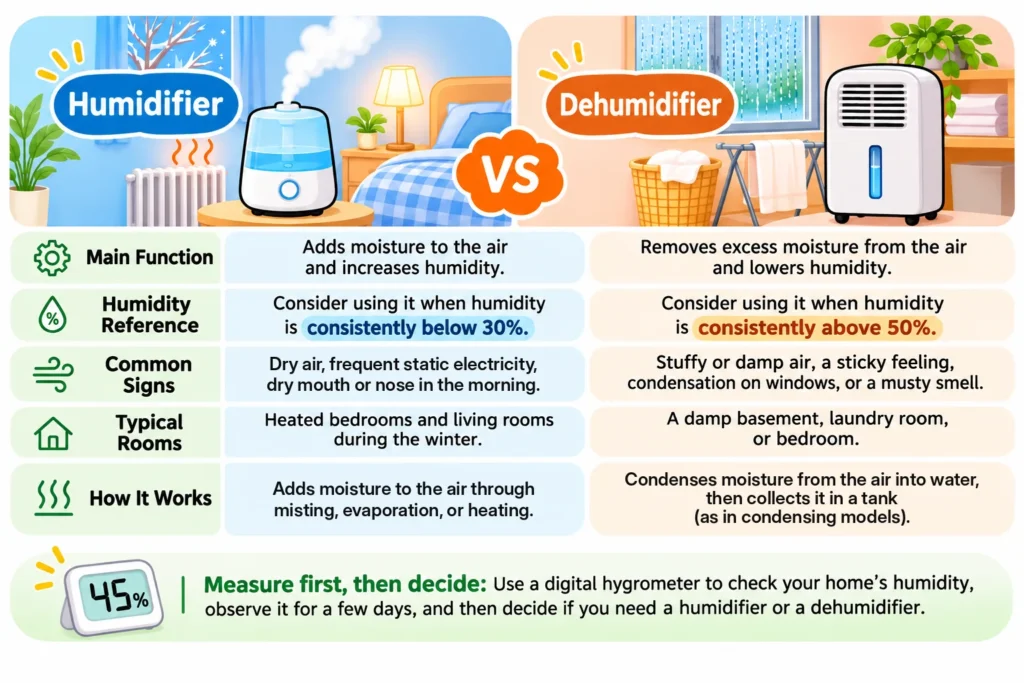
Simply put, the humidifier vs dehumidifier comparison comes down to two opposite functions: a humidifier adds moisture to the air, while a dehumidifier removes excess moisture. So, do I need a humidifier or dehumidifier?
What’s the Difference Between a Humidifier and a Dehumidifier—and Which Should I Get?
Dehumidifier vs. Humidifier at a Glance
When to Use a Humidifier or Dehumidifier
Check Your Indoor Humidity Before Choosing
All right, let’s start by checking the reading on your hygrometer and comparing it with the recommended indoor humidity range. The U.S. Environmental Protection Agency (EPA) recommends keeping indoor humidity between 30% and 50% and, to help prevent mold, below 60%. But 60% is definitely not the goal for your humidifier. The EPA also advises keeping indoor humidity at or below 50% when using a home humidifier.
So, should you use a dehumidifier or humidifier? If a room repeatedly drops below 30% and the air feels uncomfortably dry, a humidifier may help. If humidity stays above 50%, especially with condensation or a musty smell, check for moisture sources first and consider a dehumidifier if the dampness persists. If humidity is already within 30%–50%, you may not need either machine. It’s worth checking the room at different times rather than relying on a single reading.
If your home stays too dry, try setting your humidifier to 40%–45% to start. If it’s too humid, start with your dehumidifier at 45%–50%. If your machine has a built-in humidistat, let it do the work from there. In winter, don’t crank up the humidifier so much that condensation starts forming on your windows. And there’s no need to turn your dehumidifier all the way down to 30%, either. You’ll just use more electricity and make the air uncomfortably dry.

When to Use a Humidifier and Which Type to Choose
Have you ever woken up with a dry, sore throat, a parched mouth, chapped lips, and a nose that feels like it’s burning—sometimes you might even get a nosebleed? Especially in winter, when the heat has been running all night, you might wake up feeling overheated, too. By then, the air inside your home may have gotten pretty dry. Then I check the hygrometer, and the humidity is sitting at around 30%. Okay, I tell myself, it’s time to turn on the humidifier. If you’re dealing with something similar at home and the humidity keeps running low, a pretty yet practical humidifier might help ease some of that discomfort from dry air.
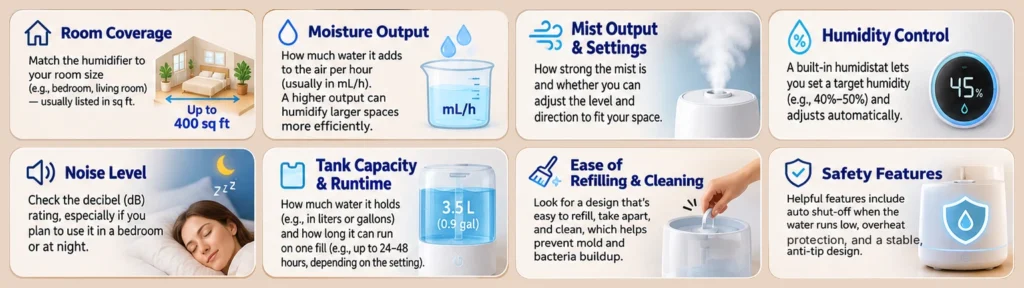
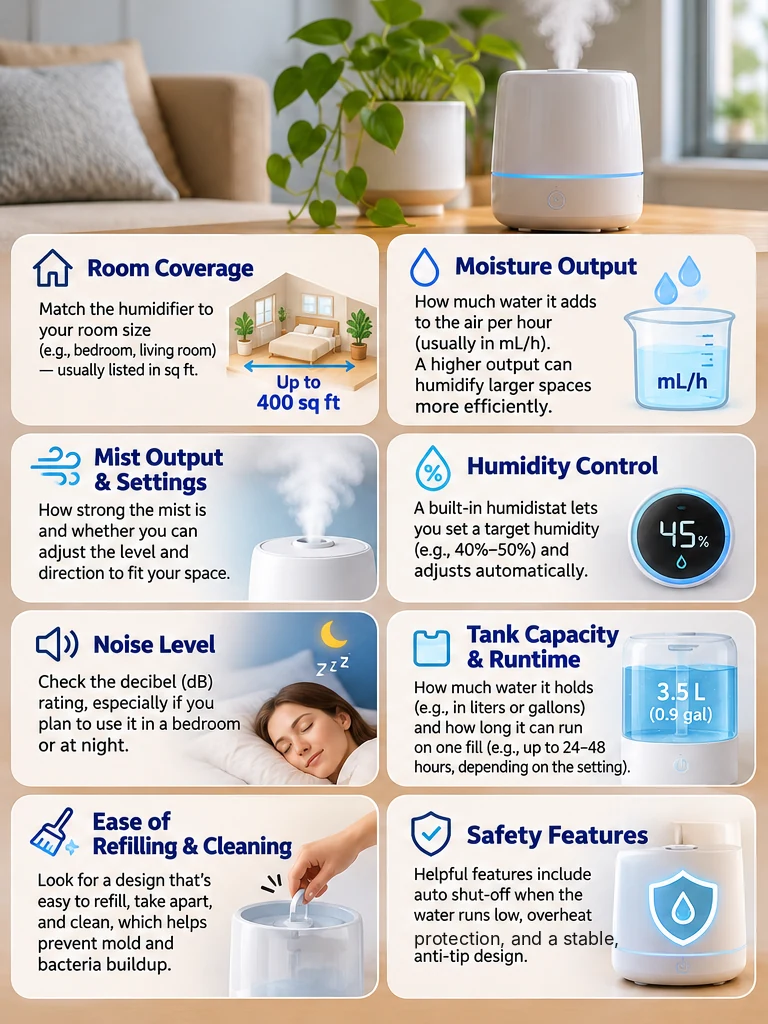
But here’s what I want to say: when you’re shopping for a humidifier, don’t just look at the price tag or how much mist it puts out. Some models produce plenty of mist but are loud enough to keep you awake at night. Others are inexpensive but a hassle to refill and clean. For families with babies, I’d also recommend checking whether a humidifier has any antibacterial or germ-reducing features. Plenty of humidifiers on the market offer these features. So, which type should you choose? It really depends on how and where you plan to use it.
8 Key Factors to Consider Before Buying a Humidifier
Humidifiers for Bedrooms and Overnight Use
Are you thinking about putting a humidifier in your bedroom, like I do? Well, that’s a good idea—but don’t keep it too close to your bed. MedlinePlus, from the U.S. National Library of Medicine, recommends placing a humidifier about 6½ feet (2 meters) away from the bed. After all, you can’t tell just by looking whether bacteria or mold are growing inside the water tank.
The U.S. Environmental Protection Agency (EPA) also warns that ultrasonic humidifiers and some other types can release microorganisms from the tank into the air along with the mist. Babies and people with sensitive airways should be especially careful. And since you’re using it in the bedroom, don’t forget about the noise, either. You don’t want your humidifier keeping you awake.
Below are a few bedroom humidifiers I’d like to share with you. If you’re looking for one, feel free to click through to see if any of them might be a good fit for your home.
Best for Quiet Overnight Use
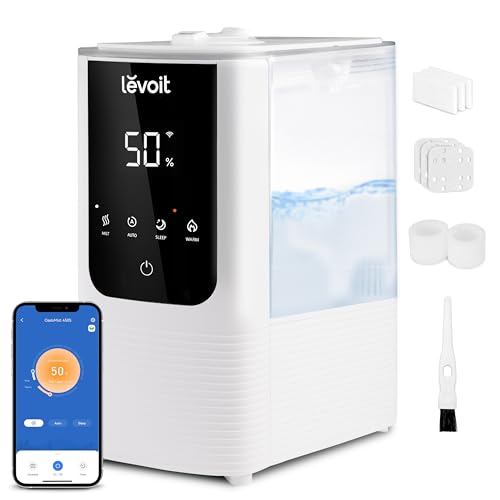
LEVOIT OasisMist 450S Smart Humidifier
🌙 Sleep Mode: Low cool-mist setting, display lights off
💧 4.5L Water Tank: Easy to refill from the top
📱 VeSync App: Humidity control and on/off schedules
Product Details
Quiet Nights & Sleep Mode
If you’re sensitive to light or noise when you’re trying to sleep, this humidifier’s Sleep Mode is worth considering. It switches to a low cool-mist setting and turns off the display lights. The noise level is rated at under 26 dB on the lowest cool-mist setting. Honestly, it’s pretty quiet when it’s running.
Warm & Cool Mist Options
You can choose between warm and cool mist, depending on your preference. The two 360° adjustable mist nozzles also let you direct the mist where you want it, away from your bedding, walls, or furniture, instead of having it spray in just one direction.
Room Coverage & Humidifying Power
This humidifier is designed for rooms around 215–430 sq ft, so it’s not just for tiny bedrooms. Its maximum cool-mist output is 300 mL per hour, while warm mist can reach up to 550 mL per hour. But here’s one thing I’d like to remind you: when you’re sleeping, more mist doesn’t necessarily mean more comfort.
4.5L Tank & Easy Cleaning
The 4.5L tank can run for up to 45 hours on the lowest mist setting, although actual runtime depends on the settings and room conditions. I also like the top-fill design and wide opening. You don’t have to turn the tank upside down just to add water. For a humidifier you might use almost every night, not having to struggle with refilling and cleaning really matters.
Smart Humidity Control
With the VeSync app, you can check the humidity, set your target humidity in Auto Mode, and schedule when the humidifier turns on and off. Being able to adjust the humidity and turn off display lights that might disturb your sleep, all from the app, is really convenient.
Aromatherapy & Automatic Shutoff
The humidifier has a separate aroma pad, so if you like, you can add a little fragrance to your room. Just remember to put essential oils on the aroma pad, not directly into the water tank. The unit also shuts off automatically when it runs out of water.
One Setting I’d Check Before Using It
Auto Mode has a default target humidity of 60%. I’d still recommend adjusting it through VeSync to the comfortable humidity range we discussed earlier. Sleep Mode is a separate feature that runs on low cool mist and turns off the display lights.
Best Mist-Free Humidifier

LEVOIT Smart Evaporative Humidifier
💨 Evaporative Design: No visible mist or white mineral dust
🌙 Sleep Mode: Low fan speed, display lights off
💧 Washable Wick Filter: Reusable; no distilled water required
Product Details
1. Mist-Free Evaporative Humidification
If you don’t like having mist floating around your bedroom, this one works a little differently. It uses a damp evaporative wick filter and airflow to add moisture to the air without releasing visible mist. The minerals in the water stay in the filter instead of being dispersed into the room as white dust.
2. Sleep Mode & Humidity Control
Sleep Mode slows down the fan and turns off the display. If you prefer a quiet, dim bedroom, this design is a great fit for you. You can also adjust your target humidity through the VeSync app. Both Auto Mode and Sleep Mode have a default humidity target of 50%, which you can change in the app.
3. Room Coverage & Water Tank
With coverage of up to about 600 sq ft and a maximum moisture output of around 400 mL per hour, this humidifier isn’t just for small bedrooms. Its 4.5L top-fill water tank allows it to run for up to 40 hours on the lowest fan setting, so you may not need to refill it every night.
4. Washable Wick Filter & Tap Water
I especially like that the evaporative wick filter is reusable. You don’t have to throw it away after a short period of use, and you can use tap water instead of buying distilled water every time. The manufacturer recommends cleaning the filter once a week, and with proper care, it can last up to two years. But if you live in an area with hard water, minerals may build up faster and shorten the filter’s actual lifespan.
5. Cleaning & Everyday Convenience
The humidifier also has Auto Dry and Descaling modes to help dry the wick filter and deal with mineral buildup. You’ll need to add citric acid as directed when using the Descaling mode. I think having these maintenance features built right into the machine is pretty handy, although the water tank and wick filter still need regular cleaning. The water tank, wick filter frame, and support frame are also dishwasher-safe. That’s so convenient.
Humidifiers for Small Rooms and Large Open Spaces
Does your living room open into the dining room or kitchen? Well, if it does, you’ll need a humidifier with a little more muscle. For a small room, though, don’t just go for the highest moisture output. Without proper humidity control, you could end up making the room too damp.
So, how big a humidifier do you actually need for your room? Take a room of about 540 square feet, for example. I think it makes more sense to start by checking the room size a humidifier is rated for, as Consumer Reports recommends, and then compare its moisture output. For example, one model has a maximum moisture output of 400 mL/h, yet the manufacturer rates it for spaces up to 600 square feet. So not every large room needs an 800 mL/h humidifier. It also depends on the room size, how dry the air is, and the actual conditions in your home.
One tip: I’d still lean toward a humidifier with a slightly larger water tank and a little extra humidifying capacity. That way, you won’t buy one only to find it can’t keep up. But I’d also look for a model that lets you adjust the moisture output and set a target humidity, automatically adjusting or shutting off once that level is reached. This makes it easier to manage in a small room and more flexible to use in a large living room.
Here are two humidifiers for you to consider.
Best for Small Rooms

LEVOIT Classic 160 2.5L
🏠 Small-Room Fit: Up to 219 sq ft
💧 Easy Top-Fill: Just lift the lid
🎚️ Simple Mist Control: Turn the dial
Product Details
1. A Good Fit for Smaller Rooms
You don’t need a huge humidifier taking up space in a small bedroom or home office. The Classic 160 is rated for rooms up to 219 sq ft, making it a practical choice when you just want to add moisture to one smaller room.
2. One Knob Keeps It Simple
There’s no complicated control panel to figure out. Just turn the knob to increase or decrease the cool mist, then point the 360-degree nozzle where you want it. I like this straightforward approach for someone who doesn’t need another smart device to manage.
3. Easy to Fill and Clean
Lift off the lid, pour in the water, and you’re done. You don’t have to flip the tank upside down to refill it. The wide opening also gives you more room to reach inside when cleaning, which is something owners of this model appreciate.
4. Quiet Enough for Overnight Use
The 2.5L tank can run for up to 25 hours on the lowest mist setting, and the quiet operation is one of the things buyers mention most often. On higher settings, you’ll need to refill it sooner, but the top-fill design makes that a quick job.
5. Automatic Shutoff for Everyday Peace of Mind
The humidifier stops when the water runs out or the tank is removed. Mist output is controlled manually rather than by a target-humidity setting, so a separate hygrometer is useful for keeping track of how damp the room is getting.
Best for Large Rooms

DREO HM717S 8L
🏠 Large-Room Coverage: Up to 600 sq ft
💧 8L Tank: Fewer trips to refill
🎯 Auto Mode: Set your humidity target
Product Details
1. More Power for a Bigger Room
Got a living room that opens into the dining area or kitchen? A small bedside humidifier might struggle to keep up. The HM717S covers up to 600 sq ft, with a maximum mist output of 550 mL/h in warm mist mode. That’s the kind of extra capacity worth looking for in a larger space.
2. A Big Tank Means Less Refilling
The 8L water tank is one of the things that makes this model appealing. It can run for up to 80 hours at a low output setting, so you’re not constantly topping it up. Buyers using higher mist settings report shorter runtimes, sometimes around a day between refills. The top-fill design helps make refilling easier.
3. Set the Humidity and Let It Adjust
I particularly like this feature for larger rooms. Choose your target humidity, and Auto Mode adjusts the mist or pauses when that level is reached. Several buyers say they appreciate being able to leave the machine to manage itself instead of constantly changing the settings. You can also monitor and schedule it through the DREO app.
4. Warm or Cool Mist, Without Much Noise
You can switch between warm and cool mist depending on the season. The cool mist setting operates as quietly as 28 dB, and the display lights can be turned off at night. Buyers of the silver model repeatedly mention how quiet it is, even when they’re using it in a bedroom.
5. Easy Refills and Everyday Care
The tank fills from the top and has a handle for carrying it. Buyers also appreciate that it’s fairly straightforward to clean. One thing worth remembering: this is an ultrasonic humidifier, so mineral-rich tap water can leave white dust behind. Distilled or properly demineralized water can help reduce that problem, and the tank still needs regular cleaning.
Humidifiers for Nurseries and Kids’ Rooms
Have a baby at home? Choosing a humidifier for the nursery takes a little extra thought. I’d start with a cool-mist humidifier or consider a mist-free evaporative model to avoid the risk of burns from hot water or steam. And make sure to keep the humidifier out of your child’s reach.
When choosing a humidifier, prioritize models that offer automatic humidity control and are easy to clean, then check whether they also have antimicrobial or disinfecting features.
Silver-Ion Antimicrobial Design

LEVOIT NeoClassic 650S 6.2L
🛡️ Silver-Ion Materials: Treated water-contact parts
🎯 Auto Mode: Set your target humidity
🧼 Easy Cleaning: Removable tray
Product Details
1. Silver-Ion Protection for Water-Contact Parts
The NeoClassic 650S uses silver-ion-treated materials to help inhibit microbial growth on certain water-contact surfaces. The product listing cites independent laboratory testing showing up to 99.9% effectiveness for up to 28 days under test conditions. The silver-ion treatment does not replace regular water changes or cleaning.
2. Cool Mist for Different Room Sizes
This cool-mist humidifier has a 6.2L water tank and a rated mist output of 320 mL/h. It covers rooms up to 536 sq ft and offers up to 62 hours of runtime, depending on the mist setting. The large tank also means fewer trips to refill it.
3. Automatic Humidity Control
Set your preferred humidity level, and Auto Mode adjusts the mist output to help maintain it. The built-in humidity sensor has a stated accuracy of ±5%, while the VeSync app lets you manage settings remotely.
4. Quiet Operation and Adjustable Lighting
At its lowest setting and in Sleep Mode, the NeoClassic 650S operates at 26 dB or less. It also has a night light with adjustable color temperature, giving parents more control over the lighting in a nursery.
5. Removable Parts for Easier Cleaning
The detachable tray makes it easier to reach areas that can collect water and residue. The tray is dishwasher-safe when cleaned according to Levoit’s instructions, while the water tank and silencer cover should be washed by hand.
Smart Nursery Humidity Control

DREO HM311S 4L
🎯 Auto Mode: Adjusts to room humidity
📱 Smart Control: App, touch, or voice
🌙 Quiet Operation: As low as 28 dB
Product Details
1. Cool Mist for Nursery Rooms
The HM311S uses ultrasonic cool mist without heating water. Its 4L tank is designed for rooms up to 300 sq ft, making it a practical option for a nursery or smaller bedroom. Three mist levels and a 30° tilting nozzle let you adjust the output and direction.
2. Automatic Humidity Control
Auto Mode monitors the humidity around the machine and adjusts mist output to help maintain your selected level. The ambient light also indicates changes in humidity, making it easier to check the room’s conditions at a glance.
3. Smart Controls for Busy Parents
You can adjust mist levels, set timers, and manage lighting through the DREO app. Touch controls and compatible Alexa or Google Assistant voice commands provide other ways to operate the humidifier without having to adjust everything directly on the machine.
4. Quiet Overnight Operation
At its quietest setting, DREO lists a noise level as low as 28 dB for this model. The 4L tank is designed to support overnight operation, with actual runtime depending on the mist setting. Its quiet operation and adjustable lighting make it worth considering for a baby’s room.
5. Easy Refilling and Everyday Care
The top-fill design lets you add water without turning the tank upside down. Removable components make regular cleaning more convenient, and the humidifier shuts off automatically when the water runs out.
How to Choose a Humidifier for Hard Water
Have you ever had this happen at home? After you’ve had the humidifier running, you notice a layer of white powder on a table or cabinet near the machine. You wipe it off, but before long, it’s back again. This could be minerals from your tap water getting carried into the air with the mist from an ultrasonic humidifier, eventually settling on the nearby furniture.
So, how can you minimize the hassle of hard water? First, it helps to understand how different humidifiers work. A mist-free evaporative humidifier uses a fan to move air through a damp wick filter. Only the water evaporates, while most of the minerals stay in the filter, helping reduce mineral dust in the air. A steam humidifier, on the other hand, heats water to produce steam. Most of the minerals remain in the water, which also helps keep mineral particles from spreading into the air.
If you’re using tap water in an area with hard water, I’d hesitate to recommend an ultrasonic humidifier. It uses high-frequency vibrations to create tiny water droplets, and minerals in the water can spread into the air along with the mist. Of course, using distilled water can help reduce this problem, too. Once you understand these differences, you’ll know which type of humidifier is a better fit for your home.
If you’re struggling to figure out how to clean hard water buildup from your humidifier, read our guide, How to Clean a Humidifier: Descaling and Everyday Care.
Best Humidifier for Hard Water: LEVOIT Superior Studio Smart 450S (4.5L)
Uses evaporation instead of ultrasonic mist, keeping most minerals in the wick filter to reduce white dust.
Machine-washable wick filter (up to 2 years with weekly washing), plus Auto Dry and Descaling modes.
Automatically adjusts fan speed to maintain target humidity, with settings and schedules through the VeSync app.
Up to 40 hours on low, up to 600 sq ft coverage, and convenient top-filling.
Treated water-contact parts help inhibit microbial growth; regular cleaning is still needed.
When to Use a Dehumidifier and Which Type to Choose
Open the basement door, and there’s a musty smell. Water droplets often collect on the windows, and even freshly washed clothes get damp again and never seem to dry. Well, if you also live in a fairly humid area and run into these problems, you might be thinking, “Does my home need a dehumidifier?”
Hold on a second. Try airing the room out first, but check whether it’s just as humid outside. Then take a look at your hygrometer. The U.S. Environmental Protection Agency (EPA) recommends keeping indoor relative humidity between 30% and 50% when possible, and below 60%. If a room stays above 60% and you feel stuffy and sticky, it’s worth considering a dehumidifier. Even during summer in a humid area, indoor humidity staying at 65% for long periods feels uncomfortable; in winter, high humidity can also cause condensation on the windows. If your home stays this damp, it also creates favorable conditions for mold to grow and dust mites to multiply. Those little guys love humid conditions even more than we do.
Thinking about buying a dehumidifier? Before you do, take a look at what you should consider.

Dehumidifiers for Bedrooms and Living Spaces
Thinking about putting a dehumidifier in your bedroom? Well, the first thing to consider is whether its noise could keep us from sleeping. I can fall asleep because I’m used to white noise. Check out this article, Brown Noise vs White Noise for Sleep: What’s the Difference?, to find out what kind of noise helps you sleep soundly. Don’t forget that the display lights can affect your sleep, too.
What else should you consider? Dehumidification capacity. Yes, that’s the most important feature. When shopping, don’t just look at how many square feet a product says it covers. Check the pints/day rating, too. For example, 20 or 30 pints per day refers to how much moisture the machine can remove from the air in 24 hours under specified test conditions.
Next up is automatic humidity control. The machine automatically adjusts how it runs based on the room’s actual humidity level. I think that’s exactly what I need, and it’s much more practical than simply setting a timer. Below, I’m sharing a few bedroom dehumidifiers. If you’re looking for a suitable dehumidifier, feel free to click through to see if any of them would be a good fit for your home.
Best for Quiet Bedroom Use

BANABIE Max 32-Pint Dehumidifier
🌙 Quiet Operation: Ultra-low noise level
🎯 Humidity Control: Auto, Continuous, and Custom modes
💧 Flexible Drainage: 2.5L tank with an included drain hose
Product Details
1. Quieter Operation for Bedroom Use
If you’re planning to put a dehumidifier in your bedroom, noise may be one of your biggest concerns. This model is designed for quiet operation, with a noise level of 32 dB. It’s also fairly compact, so it won’t take up too much space in your bedroom.
2. Three Humidity Modes for Different Needs
Auto Mode can maintain humidity at around 45%–55%. Custom Mode lets you set a target between 30% and 90% relative humidity and adjust the fan speed. If the room is especially damp, you can also use Continuous Mode. With these options, you don’t have to keep relying on a timer to manage the dehumidifier, making everyday use more convenient.
3. Compressor Dehumidification for Damp Rooms
This compressor dehumidifier is rated for spaces up to 2,500 sq ft, with a maximum moisture-removal capacity of 32 pints per day under high-temperature, high-humidity test conditions of 95°F and 90% relative humidity.
For everyday home use, I think the more valuable benefit is being able to manage persistent dampness without having to keep checking on the machine.
Whether you’re dealing with damp air in your bedroom or frequent condensation around the windows, it offers a practical way to control indoor humidity.
4. Easy Water Removal with Two Drainage Options
The removable 2.5L water tank works well for everyday use, and the machine automatically shuts off when the tank is full.
If you’d rather not empty the tank so often, you can connect the included 3.28-foot drain hose for continuous gravity drainage.
5. Convenient Features for Everyday Living
When you use a dehumidifier regularly, even the little details can make a real difference.
This model has caster wheels and carrying handles, making it easier to move between rooms. It also includes a 24-hour timer, automatic defrost, power-outage memory, and a child lock.
These features give you more useful options without making everyday operation complicated. Overall, it’s a well-rounded set of features for bedrooms and other frequently used living spaces.
Best for Everyday Dehumidification
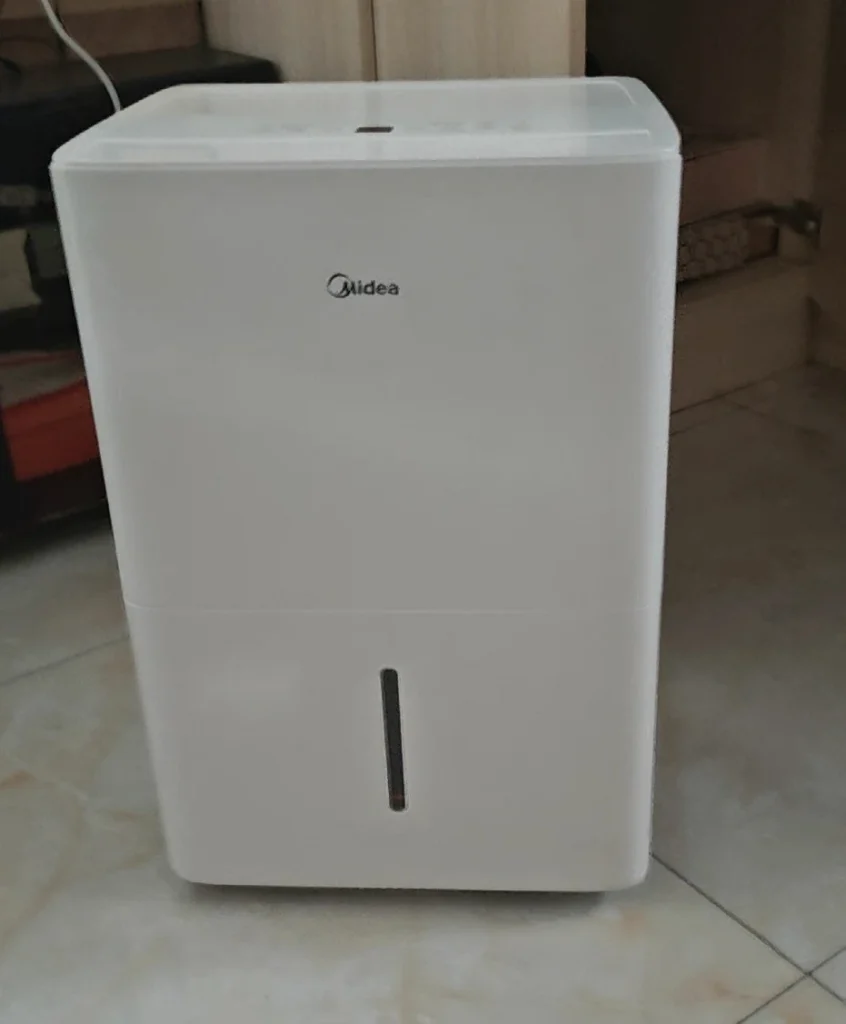
Midea 22-Pint Smart Dehumidifier
💧 22-Pint Capacity: For everyday indoor dehumidification
🎯 Auto Humidity Control: Set a target between 35% and 85%
⚡ ENERGY STAR: Certified for energy efficiency
Product Details
1. Reliable Moisture Removal for Everyday Rooms
If your bedroom or living room often feels damp and clammy, this 22-pint dehumidifier is worth considering.
It’s suitable for spaces up to 1,500 sq ft and can help remove excess moisture from everyday living areas.
What I like about it is that it focuses on what matters most in a dehumidifier: removing excess moisture and making an overly damp room feel more comfortable.
2. Automatic Humidity Control Makes Life Easier
You don’t have to keep turning the machine on and off manually. Instead, you can set your preferred humidity level anywhere between 35% and 85%. The dehumidifier then adjusts its operation based on the room’s conditions to help maintain that setting.
My suggestion is to let it run to bring the humidity down efficiently when you first turn it on, then switch to automatic humidity control once the room has dried out a bit. That’s exactly the kind of everyday convenience I value when choosing a dehumidifier.
3. Smart Controls from Your Phone
This 1,500-sq-ft Wi-Fi version also lets you check humidity levels and adjust settings through the SmartHome app. It supports compatible Alexa and Google Assistant voice commands, giving you more ways to operate the machine. This kind of app control is really handy, especially when you just want to adjust the humidity without having to walk over to the dehumidifier.
4. Easy Drainage and Room-to-Room Mobility
You can manually empty the removable water tank or connect a standard hose for continuous gravity drainage. When the tank is full, the machine automatically shuts off and can resume operation after you’ve emptied it. It also has four swivel wheels and carrying handles, making it easier to move between rooms.
5. Energy-Efficient Design with Useful Extras
This dehumidifier is ENERGY STAR certified and comes with a reusable air filter, Turbo Mode, automatic defrost, a programmable timer, and automatic restart after a power outage.
I especially like that it has Turbo Mode. When a room needs stronger dehumidification, you can use that setting. For everyday operation, automatic humidity control is more convenient.
For households that want to maintain stable humidity without constantly operating the machine by hand, it’s a thoughtful combination of features.
Dehumidifiers for Basements and Large, Damp Spaces
I don’t know if you’ve ever struggled with a damp basement. Once, after two straight days of rain, I went back down to my basement and found that the wall finish had started to bulge and peel away. I couldn’t find a spot where water was seeping through the wall, but there was an unmistakable musty smell in the air. What was I supposed to do? It was all because of the poor ventilation and lack of sunlight down there. Well, I might have to patch up the wall and do more to lower the humidity on damp days.
Here’s my suggestion: if you’re dealing with the same problem at home, try installing an exhaust fan in a suitable spot first. It might be a good idea, and an exhaust fan costs less. If an exhaust fan isn’t suitable for your situation, you may have to go with a dehumidifier instead. But you really need to think about drainage. That’s important. And another thing—does it have smart controls? You don’t want it dehumidifying at full capacity all the time and driving up your electricity bill. Below, I’m sharing two dehumidifiers I’ve chosen based on the dehumidification needs and drainage options of different spaces. Take a look and see which one might be a better fit for your home.
Best for Large Basements with Pumped Drainage

AEOCKY RHEA-3000 140-Pint Dehumidifier with Pump
💧 Built-In Pump: Up to 16.5 ft upward drainage
🏠 140-Pint Max: Designed for large, damp spaces
🎯 Smart Humidity Control: Automatic humidity management
Product Details
1. Built-In Pump Makes Basement Drainage Easier
One of the biggest advantages of this AEOCKY model is its built-in drainage pump. In a basement without a convenient floor drain, relying on gravity drainage can be frustrating. This pump can move collected water upward by as much as 16.5 feet, giving you more flexibility in choosing where the water goes.
It also comes with a 5-meter drain hose. With a suitable drainage connection, you can let the machine remove moisture without having to go downstairs and empty the tank every day. For a basement that stays damp for long periods, I think that’s a genuinely useful feature. Just make sure the drainage route stays within the pump’s limits.
2. Strong Moisture Removal for Large, Damp Spaces
A large basement needs more than an impressive square-footage number. The RHEA-3000 has a maximum moisture-removal capacity of 140 pints per day at 95°F and 95% relative humidity. At 86°F and 80% RH, its listed capacity is 95 pints per day.
For a more realistic comparison with other dehumidifiers, the ENERGY STAR standard rating is 44.34 pints per day. The unit is designed for spaces up to 8,000 square feet, although actual performance will depend on the room temperature, humidity level, and how much moisture keeps entering the space.
For a persistently damp basement, I’d pay particular attention to that daily moisture-removal capacity rather than simply choosing the machine with the largest coverage number.
3. Smart Humidity Control Without Constant Adjustments
The RHEA-3000 uses a smart humidity sensor and automatic humidity control to respond as conditions change.
You can set your preferred humidity level and let the machine manage its operation rather than relying on continuous high-capacity dehumidification all the time. That’s especially helpful when the weather changes and the basement doesn’t need the same amount of moisture removal every day.
Another useful feature is power-outage memory. The machine can resume its previous operating settings after power is restored, which is convenient for a dehumidifier you plan to use regularly.
4. ENERGY STAR Most Efficient 2025 Performance
A dehumidifier that runs regularly can add to your electricity bill, so efficiency deserves attention, especially at this price. The RHEA-3000 is ENERGY STAR Most Efficient 2025 recognized, with an integrated energy factor of 2.21 L/kWh under the certification test.
Inside, it uses a high-efficiency compressor, a multi-row heat exchanger, 7 mm copper refrigerant tubing, and hydrophilic aluminum fins. These components help transfer heat and move condensed moisture away from the coils.
I see the efficiency rating as an important part of this machine’s value. It doesn’t mean your electricity bill will drop by a fixed amount, but it gives you a useful way to judge energy performance alongside moisture-removal capacity.
5. Automatic Defrost for Cooler Basement Conditions
Basements and garages aren’t always as warm as the rest of the house. When temperatures drop, compressor dehumidifiers can become less effective, and frost may form on the coils.
The RHEA-3000 includes defrost sensors to help manage frost buildup and keep the machine operating under cooler conditions. That’s a useful feature for an unheated basement or garage where temperatures change with the seasons.
Still, automatic defrost doesn’t mean the machine will remove the same amount of moisture at every temperature. I would check the actual room temperature and the unit’s operating limits before relying on it throughout the winter.
Best for High-Capacity Basement Dehumidification
Best for Large, Damp Spaces
Best for Everyday Basement Moisture Control

Waykar 150-Pint Dehumidifier
Waykar 120-Pint Dehumidifier
Waykar 80-Pint Dehumidifier
💧 150-Pint Max: Up to 7,000 sq ft
💧 120-Pint Max: Up to 6,000 sq ft
💧 80-Pint Max: Up to 5,000 sq ft
🔄 90° Auto Swing: Helps circulate dry air
🚰 Drainage Options: 2.11-gal tank or gravity drain hose
🚰 Drainage Options: 1.14-gal tank or gravity drain hose
Product Details
1. Strong Moisture Removal for Large Spaces
During long stretches of humid weather, a large basement may need more moisture removal than a smaller dehumidifier can provide. Of these three Waykar models, the 150-Pint version offers the highest maximum capacity. It can remove up to 150 pints per day at 95°F and 90% relative humidity, with coverage listed for spaces up to 7,000 square feet.
1. Strong Moisture Removal for Large Spaces
The 120-Pint model offers a middle option for large basements and other damp living spaces. It can remove up to 120 pints of moisture per day at 95°F and 90% relative humidity, with coverage listed for spaces up to 6,000 square feet.
1. Strong Moisture Removal for Large Spaces
The 80-Pint model is a practical option for everyday basement dampness when the highest-capacity machine isn’t necessary. It removes up to 80 pints per day at 95°F and 90% relative humidity, with coverage listed for spaces up to 5,000 square feet.
2. 90° Auto-Swing Airflow for Better Circulation
The automatic 90° swing changes the direction of the outlet airflow while the dehumidifier runs. Instead of directing air toward one fixed spot, it helps move the treated air through a wider part of the room.
For a basement or large open space where air circulation isn’t ideal, this is a useful feature. It helps distribute airflow more broadly, although separate rooms and closed-off areas will still depend on their own air circulation.
3. Automatic Humidity Control for Everyday Use
The adjustable humidity range is 30%–80% relative humidity, allowing you to choose a target that suits the room. Once the setting is selected, the dehumidifier monitors humidity and adjusts its operation as conditions change.
This is especially convenient after the initial dampness has been reduced. Rather than leaving the machine running continuously without a specific target, you can let the humidity control manage routine operation. A 24-hour timer is also available when you want to schedule when the machine runs.
4. A Larger Tank and Continuous Gravity Drainage
The 150-Pint model has an 8L (2.11-gallon) removable water tank, which is larger than the tanks on the 120- and 80-Pint versions. A visible water-level window makes it easier to check the tank, and the unit can stop when the tank is full.
For a basement that needs frequent dehumidification, the included drain hose may be the more convenient choice. Connect it to a suitable lower drain, and collected water can flow out continuously without repeated manual emptying.
This version uses gravity drainage, not a built-in pump. The drainage hose needs a downward route to work properly.
4. A Water Tank or Continuous Gravity Drainage
The 120-Pint version has a removable 4.3L (1.14-gallon) water tank. You can empty it manually, or connect the included hose for continuous gravity drainage when a suitable lower drain is available.
4. A Water Tank or Continuous Gravity Drainage
The 80-Pint version has a removable 4.3L (1.14-gallon) water tank. You can empty it manually, or connect the included hose for continuous gravity drainage when a suitable lower drain is available.
During particularly humid weather, using the drain hose may be easier than emptying the tank several times a day. Like the other two options in this card, this version does not have a built-in pump.
5. Energy-Efficient Design and Practical Controls
This model is ENERGY STAR certified and includes automatic defrost to help manage frost buildup on the cooling coils. The removable, washable filter makes routine cleaning easier, while caster wheels help when the machine needs to be moved.
The 150-Pint version also has two fan speeds, a control lock, and Continuous, Dry, and Fan modes. These options provide more flexibility when humidity levels and everyday needs change.
Together, these features make it a practical choice for larger spaces that need regular moisture control without complicated day-to-day operation.
5. Energy-Efficient Design and Practical Controls
This model is ENERGY STAR certified and includes automatic defrost to help manage frost buildup during cooler conditions. The washable filter makes routine maintenance easier, and caster wheels allow the machine to be moved when needed.
With automatic humidity control, a 24-hour timer, and continuous drainage available, it offers a practical set of features for regular moisture control in larger rooms.
By now, we’ve covered the differences between humidifiers and dehumidifiers, as well as how to choose a model that fits your home’s needs. I truly hope this has been helpful. Below are a few common questions about humidifiers and dehumidifiers—perhaps some you’ve been wondering about, too.