Air Purifier vs. Humidifier: What’s the Difference, and Which Should You Choose?
We may earn a commission from affiliate links to products on this page, at no additional cost to you. Learn more
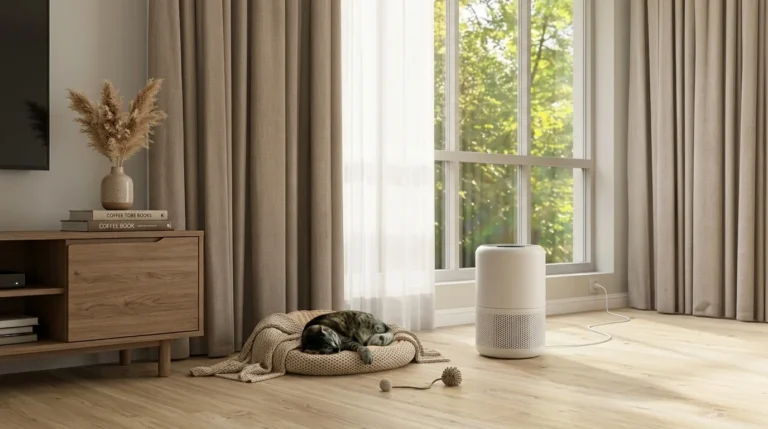
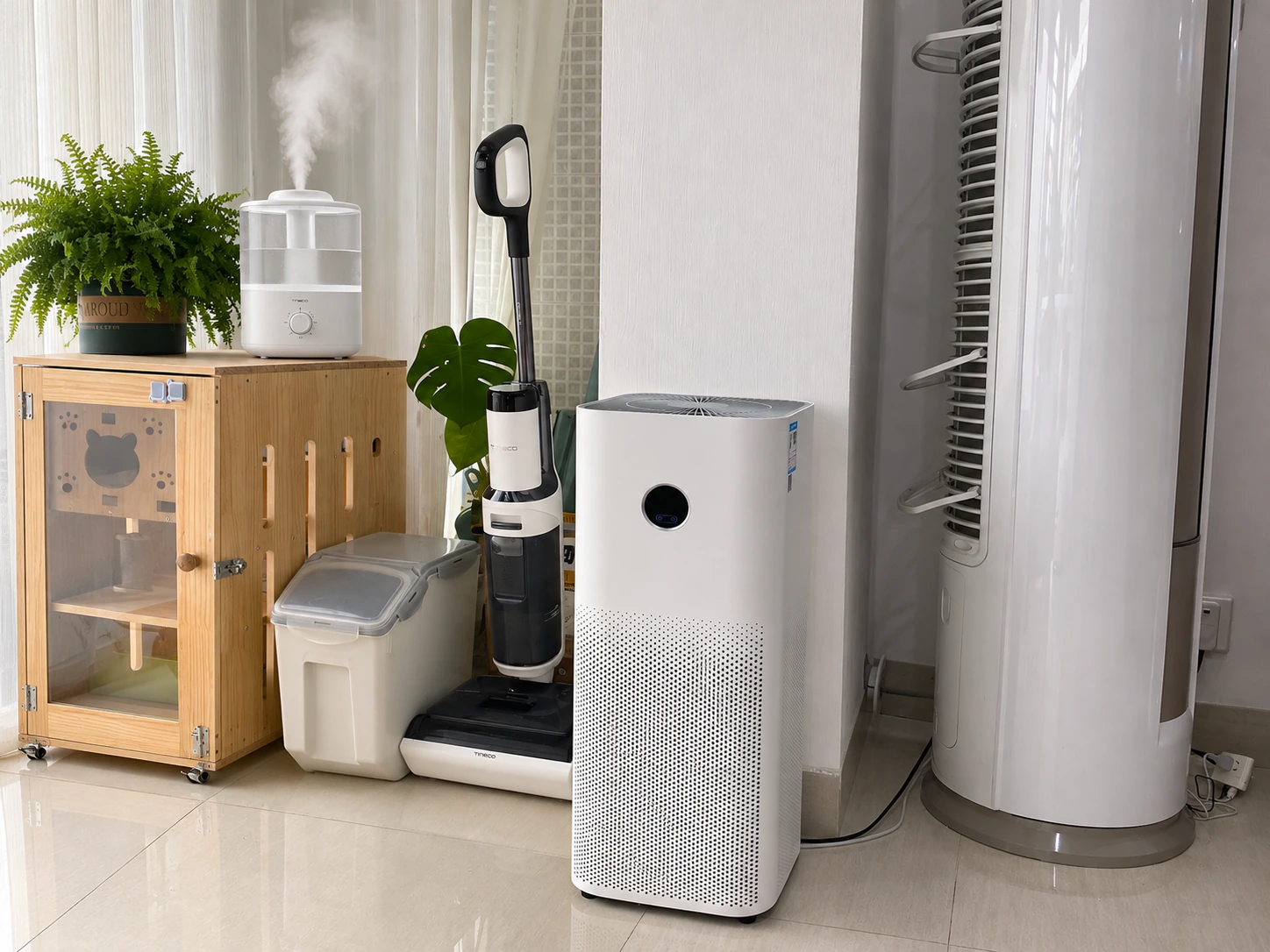
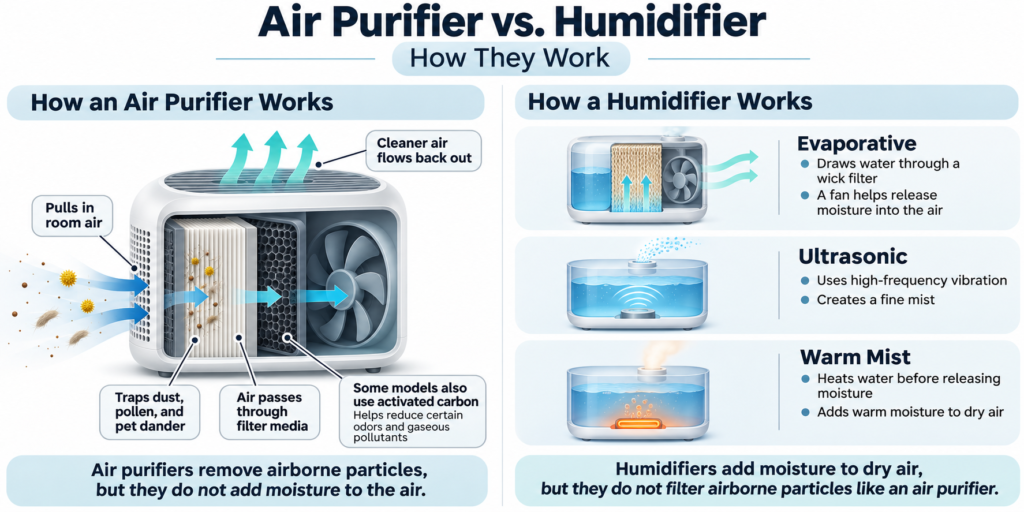
Direct answer: Air purifiers and humidifiers are both designed to improve the air in your home, but they solve different problems. An air purifier mainly filters airborne particles such as dust, pollen, and pet dander, while a humidifier adds moisture to air that’s too dry. That’s the fundamental difference between an air purifier and a humidifier. And that’s the most important thing to consider in an air purifier vs humidifier comparison.
If you have pets, deal with a lot of dust, or notice your nose feels dry after running the heat in winter, you might wonder: Should I buy an air purifier or humidifier? If airborne allergens and particles are your main concern, an air purifier is a better fit. If you’ve measured your indoor humidity and found it’s low, a humidifier is the more direct choice. Of course, some homes may face both problems, so you may need to consider them separately.
What’s the Difference Between an Air Purifier and a Humidifier?
When shopping for these two types of machines, you may notice that both product descriptions mention features like room coverage, automatic modes, and even filters. But similar features don’t mean they solve the same problems. Let’s compare how they work, what they’re used for, and the routine maintenance they require.
Humidifier vs. Air Purifier at a Glance
|
Feature |
Air Purifier |
Humidifier |
|---|---|---|
|
Main Purpose |
Filters specific airborne particles |
Adds moisture to dry air |
|
Common Uses |
Pollen, pet dander, dust, and smoke particles |
Winter heating and low indoor humidity |
|
How It Works |
Uses a fan to move air through filter media and back into the room |
Releases moisture through evaporation, ultrasonic misting, or heating |
|
Effect on Indoor Humidity |
Generally does not regulate humidity |
Increases indoor relative humidity |
|
What to Look For |
CADR, filter media, and room coverage |
Humidification capacity, humidity control, and room coverage |
|
Routine Maintenance |
Check and replace filters as recommended |
Change the water, clean the tank, and maintain filters as required for the specific model |
Air Cleaner or Humidifier: Which Should I Choose?
You may need a humidifier if:
You may want to consider an air purifier if:
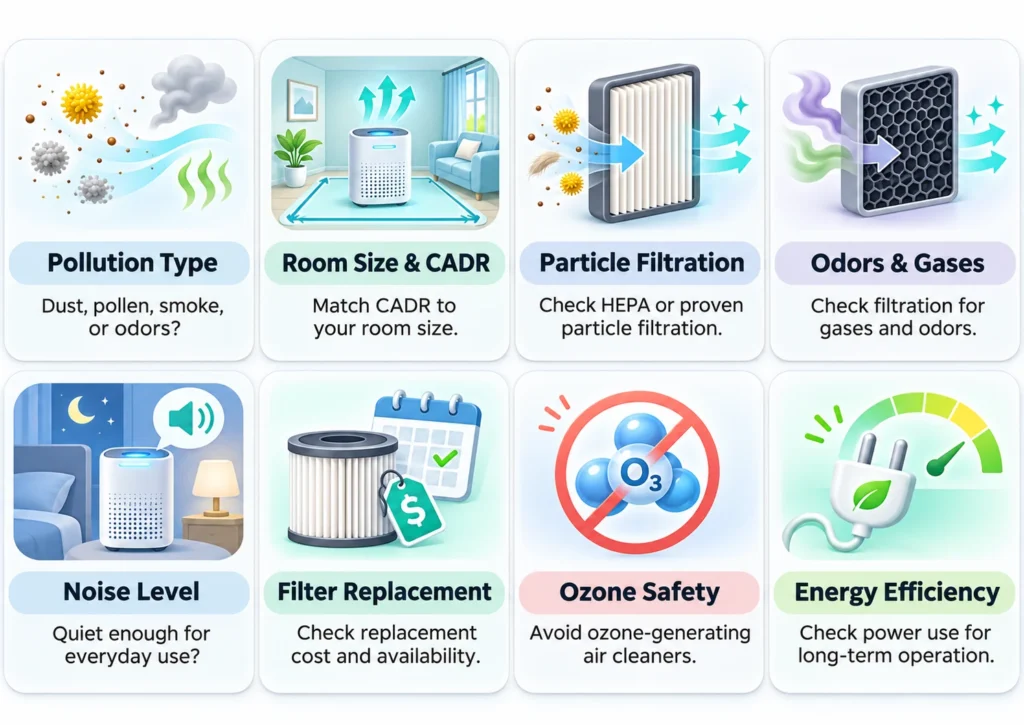
I hope these situations help you make an initial assessment. I also recommend opening your windows occasionally when outdoor air quality is good to let air circulate naturally. If you’re considering buying a machine, you’ll still need to choose carefully based on the specific problems you’re dealing with at home. Next, let’s take a closer look at what to consider when choosing an air purifier.
Find the Right Air Purifier for You
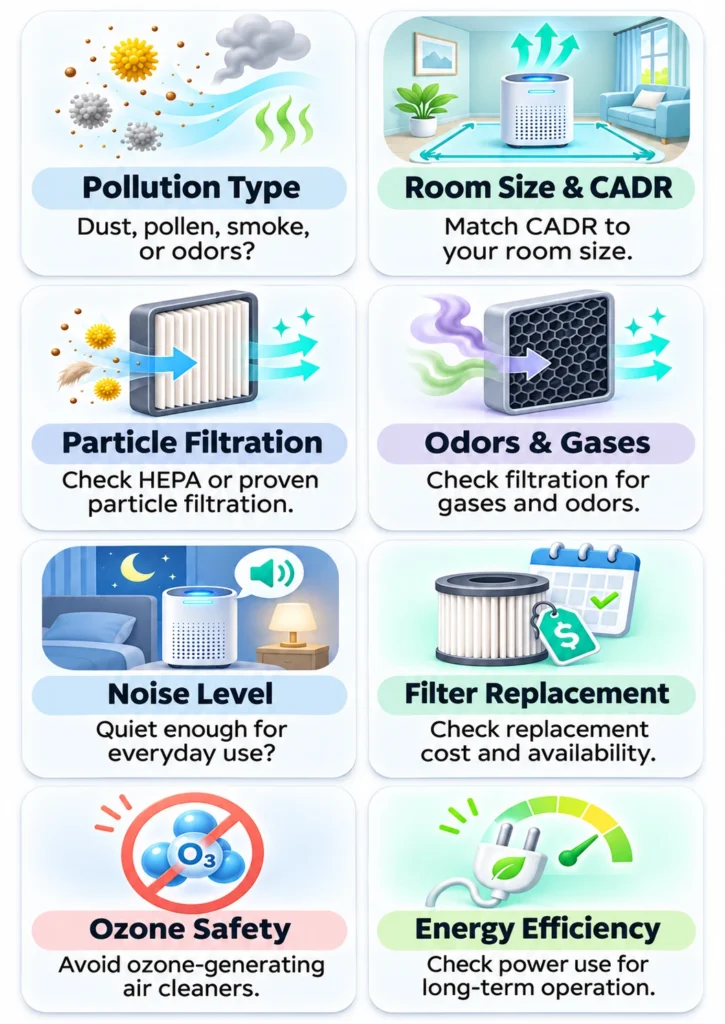
I’ve used several air purifiers, and from that experience, I’ve learned to pay particular attention to filter type and filtration performance, CADR, operating noise, maintenance costs, and features for monitoring air quality and adjusting settings automatically when choosing one.
For the recommendations below, I researched and compared dozens of air purifiers, then narrowed them down based on different home settings and how each one would be used. I hope this helps you find an air purifier that’s right for your home.
Best Overall Home Air Purifier
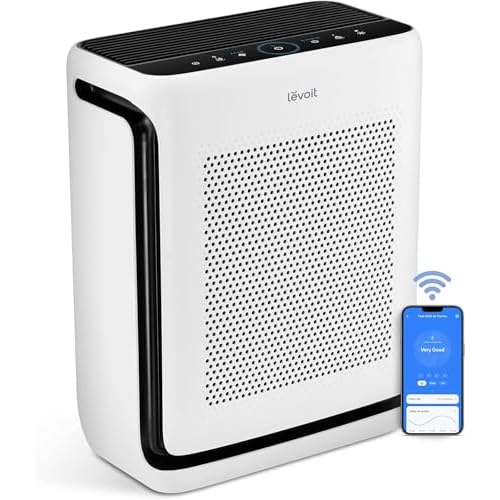
LEVOIT Vital 200S-P Smart Air Purifier
💨 250 CFM Smoke CADR: 388 sq ft at 4.8 air changes per hour
🎯 Smart Auto Mode: AirSight sensor adjusts fan speed
📱 VeSync & Easy Care: App controls and washable pre-filter
KNKA APH4000 Air Purifier
💨 226 CFM Smoke CADR: 350 sq ft at 4.8 air changes per hour
🌬️ Dual 3-Stage Filters: Front-and-back air intake with two filter sets
🎯 AQI Display & ECO Mode: Live air-quality readings and automatic standby
MOOKA KJ190H Air Purifier
🌬️ Front & Dual-Side Intake: Draws air in from the front and both sides
🎯 PM2.5 Auto Mode: Real-time air-quality display and automatic fan adjustment
🌙 Quiet Sleep & Easy Care: 20 dB Sleep Mode and washable pre-filter
Product Details
1. Strong Air Cleaning for Everyday Rooms
Choosing an air purifier by its largest advertised room size can be misleading. The Vital 200S-P has an AHAM-verified smoke CADR of 250 CFM, with dust CADR of 254 CFM and pollen CADR of 289 CFM.
At about 4.8 air changes per hour, it’s rated for a room of approximately 388 square feet. That makes it a practical option for many bedrooms, family rooms, and home offices. The much larger 1,862-square-foot figure is based on just one air change per hour, so it shouldn’t be used to judge high-frequency cleaning in a large open space.
2. Three-Stage Filtration & Pet-Friendly Air Intake
The three-stage filtration system starts with a washable pre-filter that catches larger particles such as lint and airborne pet fur. An additional U-shaped air inlet helps capture pet hair while reducing the chance of airflow becoming clogged.
The main filter captures fine airborne particles, including dust, pollen, and pet dander. An activated carbon layer also helps reduce some everyday household odors.
This combination is useful for general home air cleaning, especially in busy households with pets. However, the carbon filter isn’t a substitute for a dedicated gas-filtration system when formaldehyde or heavy VOC pollution is the main concern.
3. Smart Air Quality Monitoring & Automatic Control
The built-in AirSight infrared dust sensor monitors airborne particle levels and displays air quality through a color-coded indicator. In Auto Mode, the purifier adjusts its fan speed as particle levels change.
The VeSync app adds convenient controls. You can monitor air quality, create schedules, adjust settings, and check filter life from your phone. Compatible voice assistants are supported as well.
There’s also a Pet Mode that alternates between higher and moderate fan speeds. It’s a useful option when your pets are active and you want stronger air circulation without leaving the fan at its highest setting continuously.
4. Sleep Mode & Quiet Everyday Operation
For overnight use, Sleep Mode lowers the fan output, and the built-in light sensor can turn off the display when the room gets dark.
LEVOIT lists noise levels as low as 23 dB under its quiet operating conditions. Higher fan speeds are noticeably louder, which is normal for an air purifier moving more air.
Its relatively quiet operating settings and convenient controls offer a practical balance for everyday home use. However, the air-cleaning performance at its quietest setting shouldn’t be treated as equivalent to its performance at the highest fan speed.
5. Washable Pre-Filter & Long-Term Maintenance
The removable, washable pre-filter makes routine maintenance more manageable. LEVOIT recommends cleaning it every two to four weeks. You can vacuum away collected dust and hair, or wash the pre-filter with water and mild detergent when needed. Let it dry completely before reinstalling it.
The main particle filter and activated carbon filter are not washable. Depending on air quality and usage, they generally need to be replaced every 6–12 months.
6. Practical Size, Energy Use & Everyday Convenience
The Vital 200S-P measures 15.6 × 8.5 × 19.8 inches and weighs approximately 13.2 pounds. It needs enough open space around its air inlets and top outlet, so placement is worth considering before buying.
Rated power is approximately 50 watts. Its combination of automatic controls, filter reminders, washable pre-filter, and smartphone scheduling makes it a convenient choice for regular household use.
1. Air Cleaning Performance for Everyday Home Use
The KNKA APH4000 has a smoke, dust, and PM2.5 CADR of 226 CFM, along with a pollen CADR of 244 CFM. At approximately 4.8 air changes per hour, it’s rated for rooms up to 350 square feet.
That makes it a practical option for many bedrooms, family rooms, and home offices. For households that use an air purifier regularly, it can continuously circulate and filter airborne particles from the room.
2. Dual-Sided Airflow & Three-Stage Filtration
One standout feature of the APH4000 is its front-and-back air intake design, with a filter set on each side. Air enters from both directions and flows back into the room through the side outlets. This dual-intake design helps air circulate and pass through the filtration system efficiently.
Each filter set has three stages. The washable pre-filter catches larger particles such as hair and dust, the HEPA filter captures finer airborne particles such as pollen and pet dander, and the activated carbon layer helps reduce some cooking smells and pet-related odors.
For households dealing with everyday dust, pollen, and pet dander, this dual-filter system is a practical feature.
3. Real-Time Air Quality Display & Automatic Control
The KNKA APH4000 has a built-in air-quality sensor, with real-time PM2.5 readings and color-coded air-quality indicators on the control panel. A quick glance at the machine lets you see whether the air quality has changed.
In Auto Mode, the purifier adjusts its fan speed according to the airborne particle levels it detects. For example, if particle levels rise after cooking, the fan can speed up to filter the air. As air quality improves, it can return to a lower operating speed.
It also has an ECO Mode. When air quality is good, the purifier can enter standby and automatically restart when more air cleaning is needed. That’s useful in a home where the purifier runs for long periods, helping avoid unnecessary continuous operation.
4. Pet Mode, Sleep Mode & Adjustable Fan Speeds
If you have cats or dogs, PET Mode is a feature worth considering. It increases airflow to help capture airborne pet hair and dander while reducing some pet-related odors. When your pets are particularly active, you can use it to boost air filtration for a while.
At night, you can switch to Sleep Mode. The noise level at its quiet setting is approximately 22–24 dB, and the display lights can be dimmed to keep the bedroom relatively quiet.
The purifier also offers four manually adjustable fan speeds. You can use Auto Mode for everyday operation, increase the fan speed when stronger filtration is needed, and switch to quieter settings at bedtime.
5. Dual-Filter Maintenance & Replacement Reminders
Because the APH4000 has a filter set on both the front and back, both sides need attention during maintenance. The washable pre-filters catch larger particles such as hair and dust, and you can remove them for cleaning when buildup becomes noticeable. After washing, let them dry completely before reinstalling them.
The HEPA and activated carbon filters need periodic replacement. A built-in filter replacement indicator helps you keep track of maintenance. Under normal use, a replacement interval of about 3–6 months is a useful reference, depending on filter condition and the environment in which the purifier operates.
When buying replacement filters, choose the compatible dual-filter set for the APH4000 so both sides of the filtration system can be properly maintained.
6. Simple Controls & Everyday Convenience
The APH4000 keeps its controls on the unit itself. Along with its operating modes and four fan speeds, it offers a timer, adjustable display lighting, and a child lock. Everyday operation doesn’t require a smartphone app.
The unit measures approximately 8.15 × 12.36 × 17.09 inches and weighs about 9.68 pounds. The carrying areas on the sides also make it easier to move the purifier to another room when needed.
For households looking for an easy-to-use air purifier that can automatically manage everyday air quality, these features work well together.
1. Multi-Directional Air Intake for Everyday Home Use
The MOOKA KJ190H has a large front air inlet and additional intake openings on both sides, allowing it to draw air in from three directions. For living rooms, bedrooms, and other spaces where your family spends time, this design helps bring air into the purifier from different directions before passing it through the internal filter.
This intake design is also useful in homes with cats or dogs. As pets move around, fine hair and dander can become airborne, and the wider intake area helps draw these particles into the filtration system. Actual cleaning speed still depends on the room size and the fan speed you’re using.
2. Three-Stage Filtration & Everyday Odor Control
The KJ190H uses a three-stage filtration system. The washable pre-filter catches larger particles such as pet hair, lint, and dust. The HEPA filter captures finer airborne particles, including pollen and pet dander. An activated carbon layer also helps reduce some cooking smells and pet-related odors.
For households looking to improve everyday indoor air quality, this combination is a practical choice. In homes with pets, the pre-filter is particularly useful because it catches larger amounts of hair before they can build up directly on the main filter.
However, activated carbon filtration doesn’t replace removing the source of an odor, and it can’t guarantee the removal of all formaldehyde or other gaseous pollutants.
3. Real-Time PM2.5 Display & Automatic Control
The purifier has a built-in PM2.5 sensor that lets you check fine-particle readings on the top display, along with color-coded indicators showing the current air quality.
In Auto Mode, the KJ190H adjusts its fan speed according to the particle levels it detects. For example, cooking or cleaning may increase airborne particles, prompting the purifier to run at a higher speed. As air quality improves, it can return to a lower operating speed.
For households that want to run an air purifier regularly without constantly adjusting it, this is a convenient feature. You can leave it in Auto Mode and let the machine manage its operation as airborne particle levels change.
4. Quiet Sleep Mode & Flexible Operating Settings
When using an air purifier at night, both operating noise and display lights matter. The KJ190H’s Sleep Mode can operate as quietly as 20 dB at low fan speed while turning off the display lights to keep the bedroom relatively quiet.
For everyday use, you can also switch between four fan speeds. Increase the speed when stronger air filtration is needed, then choose a quieter setting at night. Higher speeds will be more noticeable, while lower speeds also move less air.
The purifier also includes 2-, 4-, 6-, and 8-hour auto-off timers. You can set the operating time in advance before leaving home or going to bed.
5. Washable Pre-Filter & Everyday Maintenance
The washable pre-filter is one of the KJ190H’s more practical maintenance features. It catches hair and larger dust particles before they reach the main filter. When buildup becomes noticeable, you can remove the pre-filter for cleaning. Once it’s clean and completely dry, reinstall it and continue using the purifier.
The HEPA filter and activated carbon layer still need periodic replacement, so the entire filter assembly isn’t designed to be washed and reused indefinitely. The unit also has a filter reminder that lights up after approximately 2,000 hours of use, letting you know it’s time to check and maintain the filter.
When a replacement is needed, choose a filter compatible with the KJ190H. For households that use an air purifier regularly, the washable pre-filter and replacement reminder make routine maintenance easier to manage.
6. Aromatherapy, Child Lock & Everyday Convenience
Along with its air filtration features, the KJ190H includes a separate aromatherapy pad. If you like adding a little fragrance to a room, you can apply essential oil to the pad as directed, rather than putting it directly on the filter.
The top touch-control panel keeps everyday settings in one place, including fan speed, Auto Mode, the timer, and child lock. In homes with children or pets, the lock helps prevent accidental button presses from changing the settings.
The unit measures approximately 6.1 × 12.2 × 15.75 inches and weighs about 6.7 pounds. It isn’t especially heavy to move between a bedroom, living room, or home office. There’s no need for a smartphone app, since the main functions can all be controlled directly on the unit.
Best Air Purifier for Quiet Bedrooms

LEVOIT Core 200S-P Smart Air Purifier
🌙 27 dB Sleep Mode: Quiet overnight operation with lights that can be turned off
🏠 90 CFM CADR: Suitable for bedrooms around 140 sq ft
📱 VeSync App: Phone controls, scheduling, and voice commands
DREO 539S Smart Air Purifier (DR-HAP009S)
💨 158 CFM CADR: Suitable for bedrooms around 245 sq ft
🌙 Quiet Sleep Mode: Low-noise operation with adjustable display brightness
🎯 PM2.5 Auto Mode: Real-time air-quality monitoring and automatic fan adjustment
Product Details
1. Air Cleaning for Smaller Bedrooms
The LEVOIT Core 200S-P has a CADR of 90 CFM. At approximately 4.8 air changes per hour, it’s suited to rooms around 140 square feet. That makes it a practical option for smaller bedrooms, kids’ rooms, and home offices without taking up space with a large machine.
It can continuously circulate and filter airborne particles from the room. However, if your bedroom is significantly larger or you need to remove airborne contaminants more quickly, a model with greater cleaning capacity would be a better choice.
2. 360° Air Intake & Three-Stage Filtration
The Core 200S-P uses a 360-degree air intake design, drawing air in from around the unit before passing it through its three-stage filter. Its compact cylindrical shape makes it easier to find a spot in the bedroom without taking up much room.
The nylon pre-filter catches larger particles such as hair, lint, and dust. The main filter captures airborne particles including pollen, pet dander, and fine dust, while the activated carbon layer helps reduce some everyday household odors.
For households looking to reduce airborne particles in the bedroom, this filtration system offers a practical combination of features.
3. Quiet Sleep Mode & Separate Night-Light Controls
A bedroom air purifier needs to do more than filter the air. Its operating noise and lights matter, too. The Core 200S-P’s Sleep Mode lowers the fan speed, with a minimum listed noise level of 27 dB, helping keep the bedroom relatively quiet overnight.
It also has a separate night light with two brightness settings that can be turned off completely. The control-panel display and night light are managed separately, so you can turn both off before bed instead of leaving the machine glowing all night.
During the day, you can increase the fan speed when stronger air cleaning is needed. Higher speeds will be louder, though, and the quietest Sleep setting won’t move as much air as the highest fan speed.
4. VeSync Smart Controls & Scheduling
With the VeSync app, you can adjust fan speed, set timers, and schedule when the purifier turns on and off each day. It’s also compatible with Amazon Alexa and Google Assistant, so you don’t always have to walk over to the machine to change a setting.
For example, you can schedule it to run before bedtime or set operating times around your daily routine. That’s convenient if you use an air purifier in your bedroom regularly.
One distinction worth knowing is that the Core 200S-P doesn’t have an air-quality sensor, so it won’t automatically change fan speed in response to airborne particle levels. Its smart features mainly focus on remote operation and scheduling.
5. Filter Maintenance & Replacement Reminders
The pre-filter is part of the main filter assembly and can’t be removed for washing. Every two to four weeks, you can use a soft brush or vacuum to clean dust and hair from the outer layer and help keep airflow unobstructed.
The entire filter generally needs replacing every 6–8 months, although actual filter life depends on how often the purifier runs and the air quality in your home.
The unit includes a filter replacement reminder, and the VeSync app also lets you check the remaining filter life. For households that run an air purifier regularly, these features make maintenance easier to plan without relying entirely on memory.
6. Compact Size & Everyday Convenience
The Core 200S-P measures approximately 8.1 × 8.1 × 12.6 inches and weighs about 6.6 pounds. It doesn’t take up much space on a stable bedroom cabinet or another suitable surface, and it’s relatively easy to move when needed.
Rated power is 37 watts. Everyday functions are accessible through the top control panel, while the smartphone app provides additional convenience.
For households that don’t need advanced air-quality monitoring and mainly want continuous air filtration in a smaller bedroom, this is an easy-to-use and manageable air purifier.
1. Stronger Air Cleaning for Bedrooms
The DREO 539S has a CADR of 158 CFM. At approximately 4.8 air changes per hour, it’s suited to rooms around 245 square feet. That gives it more air-cleaning capacity for larger bedrooms, home offices, and smaller living spaces.
Its 360-degree air intake draws air in from around the unit before passing it through the internal filtration system.
If your bedroom sees a lot of activity during the day, or you want stronger filtration for a shorter period, you can increase the fan speed. At night, you can switch to a quieter setting to balance air cleaning with a comfortable sleeping environment.
2. Quiet Sleep Mode & Adjustable Display Lighting
The DREO 539S’s Sleep Mode lowers the fan speed to keep operating noise down at night. That’s useful for households that want to continue filtering bedroom air while keeping fan noise relatively unobtrusive.
You can also adjust the brightness of the display area through the app to reduce nighttime light. Higher fan speeds and Turbo Mode will be noticeably louder, making them more suitable when stronger air cleaning is needed.
Since quiet settings move less air than the highest fan speed, it’s worth considering both operating noise and actual room size when choosing an air purifier for the bedroom.
3. Real-Time PM2.5 Monitoring & Automatic Fan Control
The 539S has a built-in air-quality sensor that displays real-time PM2.5 readings on the unit, along with color-coded indicators showing current air conditions. That makes it easier to notice changes in air quality instead of relying on how the room feels.
In Auto Mode, the purifier adjusts its fan speed according to the airborne particle levels it detects. For example, dusting or changing your bedding can temporarily increase airborne particles, prompting the fan to run faster. As air quality improves, the purifier can return to a lower speed.
For households that want to leave an air purifier running regularly without constantly adjusting it, this automatic control is especially convenient.
4. Three-Stage HEPA Filtration & Everyday Air Cleaning
The DREO 539S uses a three-stage filtration system with a pre-filter, HEPA filter, and activated carbon layer.
The pre-filter catches hair, lint, and larger dust particles. The HEPA filter captures finer airborne particles, including pollen, pet dander, fine dust, and smoke particles. The activated carbon layer helps reduce some everyday household odors.
This combination is useful for regular bedroom air cleaning, especially in rooms where dust tends to accumulate or in homes with pets. However, activated carbon filtration doesn’t replace ventilation or removing the source of an odor.
5. DREO App, Voice Control & Scheduling
This white Wi-Fi model connects to the DREO app, allowing you to monitor air quality, adjust fan speed, create operating schedules, and check filter status from your phone.
Along with the regular fan speeds and Auto Mode, the app lets you activate Turbo Mode when stronger filtration is needed. Compatible voice control also makes everyday adjustments more convenient.
For example, you can schedule the purifier to run before you head into the bedroom at night, then switch to a quieter setting at bedtime. This makes it easier to plan air cleaning around your routine without constantly operating the machine just before going to sleep.
6. Filter Maintenance & Practical Size
The DREO 539S’s outer pre-filter can be cleaned periodically with a soft brush to reduce accumulated dust and hair. The complete filter generally needs replacing every 6–8 months, depending on running time, fan speed, and indoor air conditions.
The purifier includes a filter replacement reminder, and you can also check filter status through the app. When buying replacements, choose the filter made for the white DR-HAP009S model to avoid ordering one intended for a different version.
The unit measures approximately 9.3 × 9.3 × 15.4 inches and weighs about 6.6 pounds. Despite its stronger cleaning capacity, it remains relatively compact and can be moved between a bedroom and home office when needed.
For households looking for a bedroom air purifier that combines quiet operation, stronger particle filtration, and automatic air-quality management, the DREO 539S offers a well-rounded set of features.
Best for Allergies & Pet Dander

LEVOIT Vital 100S-P Smart Air Purifier
🐾 Pet-Friendly Air Intake: Wide U-shaped opening helps capture airborne pet fur
💨 143 CFM CADR: 222 sq ft at 4.8 air changes per hour
🧼 Pet Mode & Washable Pre-Filter: Easier everyday maintenance for homes with pets
WINIX 5530 Carbon True HEPA Air Purifier
💨 253 CFM Smoke CADR: 392 sq ft at 4.8 air changes per hour
🛡️ True HEPA & AOC Carbon: Fine-particle filtration with everyday odor control
📱 Smart Auto & Wi-Fi: Air-quality sensing, color indicators, and app controls
Product Details
1. Air Cleaning for Small to Medium Rooms
The LEVOIT Vital 100S-P has a CADR of 143 CFM. At approximately 4.8 air changes per hour, it’s suitable for rooms around 222 square feet. For bedrooms, home offices, and moderately sized living spaces with cats or dogs, it can continuously circulate and filter airborne dust, pollen, and pet dander.
In homes where pets are active, fur and fine particles can become airborne again as people walk around, change bedding, or clean. Running an air purifier regularly can help reduce those suspended particles.
However, if your room is much larger or you need faster air cleaning, a model with a higher CADR would be a better fit.
2. U-Shaped Air Intake & Pet Mode
One practical feature of the Vital 100S-P is its wide, U-shaped auxiliary air inlet. In homes with cats or dogs, it helps draw in airborne fur and larger particles while reducing the chance of hair clogging the intake area.
The purifier also includes Pet Mode, which alternates between fan speeds to maintain air circulation without running at full power continuously. It’s convenient when pets move around the room throughout the day and you don’t want to leave the fan on its highest setting.
Keep in mind that an air purifier can only capture fur and dander that reach the airflow. Hair already settled on sofas, carpets, or pet beds still needs to be removed with a vacuum or other cleaning tools.
3. Three-Stage Filtration for Pet Allergens
The Vital 100S-P uses a three-stage filtration system. Its removable pre-filter catches hair, lint, and larger dust particles. The main filter captures finer airborne particles, including pollen, pet dander, and fine dust, while the activated carbon layer helps reduce some everyday household odors.
Each layer serves a different purpose. The pre-filter keeps larger debris from building up on the main filter, the main filter handles finer particles, and the carbon layer helps manage some pet-related smells.
If pet dander and odors are a particular concern, you can also purchase a compatible Pet Allergy replacement filter for the Vital 100S-P. It’s a separate filter option, not an additional filter included with the purifier, so check which version you’re buying.
4. Air Quality Sensing & VeSync Smart Controls
A built-in infrared dust sensor monitors changes in airborne particles and shows the room’s current air quality through the unit’s indicator lights.
In Auto Mode, the purifier adjusts its fan speed based on the detected air conditions. For example, vacuuming or shaking out a pet blanket may temporarily send more particles into the air, prompting the unit to increase its cleaning speed.
The VeSync app also lets you check air quality, change settings, create operating schedules, and monitor filter life. Compatible voice controls are supported as well. For households that want an air purifier running on a regular schedule, these features reduce the need for constant manual adjustments.
5. Quiet Operation & Compact Design
The Vital 100S-P includes Sleep Mode, with a minimum operating noise level of 23 dB. Its light-detection feature can also help with overnight use by reducing fan output and turning off the display lights.
During the day, you can increase the fan speed when stronger air filtration is needed, then switch to a quieter setting at night. Lower fan speeds also move less air, though, so Sleep Mode shouldn’t be treated as having the same cleaning capacity as the highest setting.
The unit measures approximately 12.6 × 6.3 × 16.0 inches and weighs about 8.6 pounds, with a rated power of 35 watts. Its compact size makes it a practical option for households with limited space that still want regular air filtration.
6. Washable Pre-Filter & Long-Term Maintenance
For households with pets, the removable, washable pre-filter is one of the Vital 100S-P’s most useful features. When hair and larger dust particles accumulate, you can clean the surface with a vacuum or soft brush. If needed, the pre-filter can also be washed with water and a little mild detergent.
Check and clean the pre-filter approximately every 2–4 weeks. After washing, let it dry completely before reinstalling it.
The main particle filter and activated carbon layer are not washable and need periodic replacement. The user manual gives a general interval of about 9–12 months, although heavy pet shedding, dusty conditions, or long operating hours may require earlier replacement. The VeSync app and filter reminder help you keep track of maintenance.
1. Stronger Air Cleaning for Medium to Large Rooms
The WINIX 5530 has an AHAM-verified smoke CADR of 253 CFM, along with a dust CADR of 252 CFM and pollen CADR of 247 CFM. At approximately 4.8 air changes per hour, it’s rated for rooms around 392 square feet.
That gives it more air-cleaning capacity for living rooms, larger bedrooms, and shared spaces where pets spend time. When grooming, cleaning, or everyday activity sends more dander and dust into the air, you can increase the fan speed for stronger filtration.
Although the purifier also lists a much larger one-air-change coverage area, the 392-square-foot rating is the more useful reference when you want frequent air cleaning for airborne allergens. The 1,882-square-foot figure shouldn’t be treated as offering the same cleaning frequency.
2. True HEPA Filtration & Washable Pre-Filter
The WINIX 5530 has three physical filtration layers: a fine-mesh pre-filter, an AOC activated carbon filter, and a True HEPA particle filter.
The pre-filter catches airborne pet hair, lint, and larger dust particles before they build up on the inner filters. The True HEPA filter handles finer airborne particles, including pollen, pet dander, fine dust, and smoke particles.
For homes with shedding cats or dogs, this layered design is useful. Larger debris gets caught first, while finer allergens pass through the main particle filter. The removable pre-filter can also be washed, making routine maintenance more manageable.
3. Pellet-Based Carbon Filter & Optional PlasmaWave
The WINIX 5530 uses an AOC activated carbon filter with carbon pellets rather than a simple thin carbon-coated sheet. This helps reduce some everyday odors from pets, cooking, and other household activities.
An air purifier still can’t replace cleaning a litter box, washing pet bedding, or removing other odor sources. And like other consumer air purifiers, its carbon filter shouldn’t be relied on as the only solution for high concentrations of gaseous pollutants.
The unit also includes PlasmaWave ionization technology, which can be switched on or off independently. Because ionization can produce trace amounts of ozone, you can leave this feature disabled if you prefer not to use it. The purifier’s physical filtration layers continue to work without PlasmaWave.
4. Smart Air Quality Sensing & Wi-Fi Controls
The WINIX 5530 has built-in air-quality sensing and an Auto Mode that adjusts fan speed according to detected conditions. This makes it easier to keep the purifier running without constantly changing settings yourself.
A front-facing indicator uses blue, amber, and red lights to show different air-quality conditions. It isn’t a numerical PM2.5 display, so the colors shouldn’t be interpreted as precise particle-concentration readings.
The Winix Smart app adds Wi-Fi controls, allowing you to adjust settings, check operating status, and set timers from your phone. Compatible Alexa voice controls are also supported. For a purifier placed across a larger living room, remote operation can be especially convenient.
5. Automatic Sleep Mode & Practical Placement
The WINIX 5530 runs quietly at low fan speeds, with a minimum listed noise level of approximately 23.5 dB. Its light sensor can automatically activate Sleep Mode when the room gets dark, lowering fan speed and dimming the indicator lights. When the room brightens, it returns to automatic operation.
That’s convenient when you’re watching TV, reading, or using the purifier overnight. Higher fan speeds and Turbo Mode will be noticeably louder, though, and the display lights can’t be completely turned off manually like those on some other models.
The unit measures approximately 13.59 × 8.27 × 22.17 inches and weighs about 13.3 pounds. It’s taller and heavier than the LEVOIT Vital 100S-P, making floor placement more practical. Leave adequate clearance around the air intake and outlet for proper airflow.
6. Filter Replacement & Long-Term Maintenance
The WINIX 5530’s fine-mesh pre-filter can be cleaned regularly and washed when needed. Let it dry completely before putting it back in the unit so moisture doesn’t reach the inner filters.
The True HEPA and AOC pellet-based carbon filters are not washable. Both have a recommended replacement interval of approximately 12 months, although actual filter life depends on indoor dust levels, pet shedding, and operating time.
The purifier uses the WINIX Filter Q replacement set, which contains compatible HEPA and carbon filters. It also includes a filter replacement reminder. When ordering supplies, make sure they’re designed for the 5530 rather than the older 5500-2.
For households that want stronger filtration of airborne allergens and pet dander in a larger room, the WINIX 5530 combines substantial cleaning capacity, manageable pre-filter maintenance, and a yearly filter replacement schedule.
Best for Smoke & Household Odors
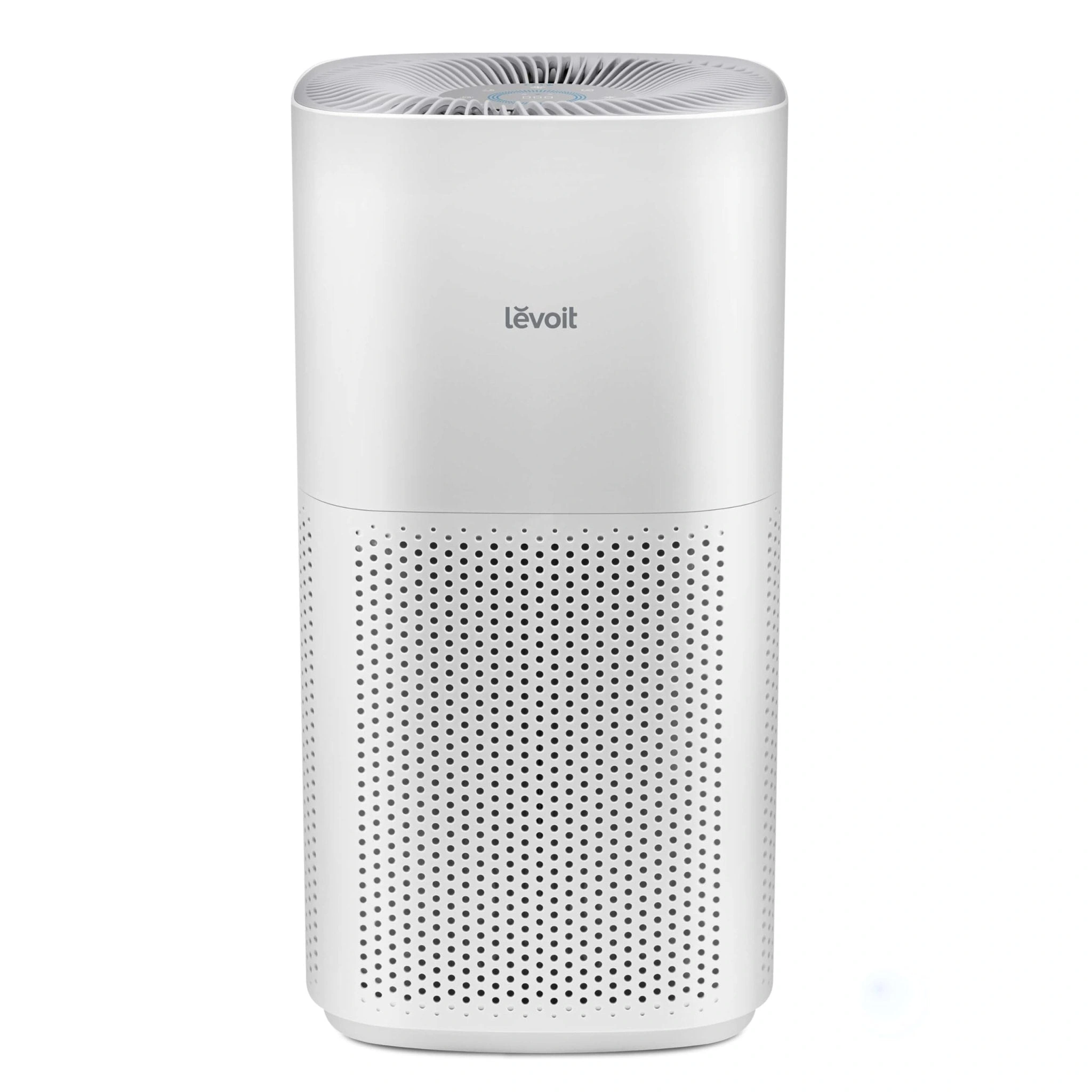
LEVOIT Core 600S-P Smart Air Purifier
💨 391 CFM Smoke CADR: 606 sq ft at 4.8 air changes per hour
🌫️ 3-Stage Filtration & Carbon: Captures smoke particles and helps reduce some household odors
📱 PM2.5 Auto & VeSync: Real-time air-quality display, automatic fan adjustment, and app control
Product Details
1. Strong Smoke Particle Filtration for Large Rooms
The LEVOIT Core 600S-P has a smoke CADR of 391 CFM. At approximately 4.8 air changes per hour, it’s suited to rooms around 606 square feet. For larger living rooms, open-concept spaces, or households that regularly need to deal with airborne smoke particles, it provides substantial air-cleaning capacity.
For example, a higher CADR can help clear fine smoke particles left in the air after cooking or when outdoor wildfire smoke affects indoor air quality. However, if your space is especially large or airflow between different areas is limited, a single purifier’s effectiveness will also depend on the room layout.
2. Three-Stage Filtration & Everyday Odor Control
The Core 600S-P uses a three-stage filtration system. The outer pre-filter catches hair, lint, and larger dust particles. The main filter captures fine airborne particles, including smoke particles, pollen, and pet dander. The activated carbon layer helps reduce some cooking smells and everyday household odors.
Its carbon filter contains activated carbon pellets that can adsorb certain gaseous pollutants. However, smoke particles and smoke odors aren’t the same thing. The 391 CFM smoke CADR measures particle-cleaning performance, not how effectively the purifier removes every odor or volatile organic compound.
For cooking fumes and odors, a range hood should still be your first line of defense. If there’s a noticeable source of household odors, cleaning up or removing that source matters more than relying entirely on an air purifier.
3. Optional Smoke Remover & Specialty Replacement Filters
The Core 600S-P comes with a standard three-stage filter already installed, suitable for everyday particle filtration and some household odor control. If wildfire smoke is a recurring concern, you can separately purchase the Smoke Remover replacement filter designed for this model.
The Smoke Remover filter uses a four-stage design that focuses on ash, particles from wildfire smoke, and related pollutants. LEVOIT also offers a Toxin Absorber filter designed for concerns such as traffic exhaust, smoke, and certain gaseous pollutants.
These are optional replacement filters, not accessories included with the purifier or extra layers added on top of the original filter. Choose the complete replacement filter that matches your air-quality needs, while keeping in mind that no single filter can guarantee removal of every smoke odor or harmful gas.
4. Real-Time PM2.5 Monitoring & Automatic Air Control
The Core 600S-P has an AirSight Plus laser dust sensor that displays real-time PM2.5 readings, along with air-quality indicator lights showing current airborne particle conditions.
In Auto Mode, the purifier adjusts its fan speed according to the particle levels it detects. For example, cleaning or cooking may temporarily increase fine airborne particles, prompting the purifier to run faster. As the readings improve, it can return to a lower speed.
One important distinction is that this automatic control responds primarily to airborne particles. It doesn’t directly measure every gas or odor, so the fan won’t necessarily speed up just because a noticeable smell remains in the room.
5. VeSync Smart Controls & Quiet Operation
Through the VeSync app, you can monitor air-quality changes, adjust fan speed, create daily schedules, and check filter life. The Core 600S-P also supports compatible voice controls through Amazon Alexa and Google Assistant.
It includes Sleep Mode and a light sensor that can turn off the display lights when the room gets dark. Its lowest listed operating noise level is 26 dB, making quieter settings practical when you want less background noise.
However, this is a purifier designed for larger spaces. Higher fan speeds will be noticeably louder, while quieter settings also move less air. When you need to reduce smoke particles quickly, you’ll have to balance cleaning speed with operating noise.
6. Filter Maintenance, Size & Long-Term Costs
The Core 600S-P’s pre-filter is part of the main filter assembly and can’t be removed for washing. Every 2-4 weeks, you can use a soft brush or vacuum to clean accumulated dust from the outer layer and help maintain airflow.
The complete filter generally needs replacing every 6-12 months. If your home regularly experiences heavy smoke, dust, or other airborne pollutants, you may need to replace it sooner. The VeSync app and filter reminder help you keep track of maintenance. Since standard and specialty smoke filters are purchased separately, replacement costs are also worth considering.
The purifier measures approximately 12.3 × 12.3 × 23.6 inches and weighs about 13.7 pounds. It works best on a stable floor surface with enough clearance around the air intake and top outlet to keep air moving freely.
Tip: If you have cats or dogs at home, I recommend paying extra attention to the filter setup and routine maintenance when choosing an air purifier. I think the best choice is a model with a pre-filter you can clean, an activated carbon layer, and replaceable filters. If you want to learn more about choosing an air purifier for pets, take a look at Best Air Purifier for Pets: What Works for Hair, Dander & Odors.
When to Use a Humidifier and Which Type to Choose
Have you ever woken up with a dry, sore throat, a parched mouth, chapped lips, and a nose that feels like it’s burning—sometimes you might even get a nosebleed? Especially in winter, when the heat has been running all night, you might wake up feeling overheated, too. By then, the air inside your home may have gotten pretty dry. Then I check the hygrometer, and the humidity is sitting at around 30%. Okay, I tell myself, it’s time to turn on the humidifier. If you’re dealing with something similar at home and the humidity keeps running low, a pretty yet practical humidifier might help ease some of that discomfort from dry air.
But here’s what I want to say: when you’re shopping for a humidifier, don’t just look at the price tag or how much mist it puts out. Some models produce plenty of mist but are loud enough to keep you awake at night. Others are inexpensive but a hassle to refill and clean. For families with babies, I’d also recommend checking whether a humidifier has any antibacterial or germ-reducing features. Plenty of humidifiers on the market offer these features. So, which type should you choose? It really depends on how and where you plan to use it.
I also pay attention to the water quality at home. Ultrasonic humidifiers may leave white dust on furniture if you use tap water with a lot of minerals. Evaporative humidifiers usually help reduce this problem, but their filters still need regular cleaning or replacement. Steam humidifiers heat water to produce steam, so if you have young children at home, you also need to be especially careful about burns.
I compared different humidifiers with overnight bedroom use, water quality, and everyday maintenance in mind, then carefully selected the two models below.
Best for Quiet Overnight Use
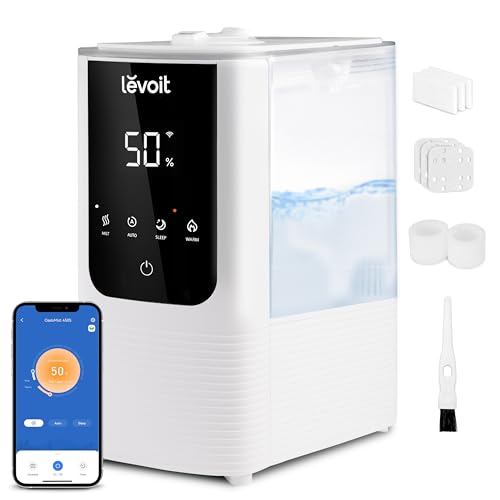
LEVOIT OasisMist 450S Smart Humidifier
🌙 Sleep Mode: Low cool-mist setting, display lights off
💧 4.5L Water Tank: Easy to refill from the top
📱 VeSync App: Humidity control and on/off schedules
Product Details
Quiet Nights & Sleep Mode
If you’re sensitive to light or noise when you’re trying to sleep, this humidifier’s Sleep Mode is worth considering. It switches to a low cool-mist setting and turns off the display lights. The noise level is rated at under 26 dB on the lowest cool-mist setting. Honestly, it’s pretty quiet when it’s running.
Warm & Cool Mist Options
You can choose between warm and cool mist, depending on your preference. The two 360° adjustable mist nozzles also let you direct the mist where you want it, away from your bedding, walls, or furniture, instead of having it spray in just one direction.
Room Coverage & Humidifying Power
This humidifier is designed for rooms around 215–430 sq ft, so it’s not just for tiny bedrooms. Its maximum cool-mist output is 300 mL per hour, while warm mist can reach up to 550 mL per hour. But here’s one thing I’d like to remind you: when you’re sleeping, more mist doesn’t necessarily mean more comfort.
4.5L Tank & Easy Cleaning
The 4.5L tank can run for up to 45 hours on the lowest mist setting, although actual runtime depends on the settings and room conditions. I also like the top-fill design and wide opening. You don’t have to turn the tank upside down just to add water. For a humidifier you might use almost every night, not having to struggle with refilling and cleaning really matters.
Smart Humidity Control
With the VeSync app, you can check the humidity, set your target humidity in Auto Mode, and schedule when the humidifier turns on and off. Being able to adjust the humidity and turn off display lights that might disturb your sleep, all from the app, is really convenient.
Aromatherapy & Automatic Shutoff
The humidifier has a separate aroma pad, so if you like, you can add a little fragrance to your room. Just remember to put essential oils on the aroma pad, not directly into the water tank. The unit also shuts off automatically when it runs out of water.
One Setting I’d Check Before Using It
Auto Mode has a default target humidity of 60%. I’d still recommend adjusting it through VeSync to the comfortable humidity range we discussed earlier. Sleep Mode is a separate feature that runs on low cool mist and turns off the display lights.
Best Mist-Free Humidifier

LEVOIT Smart Evaporative Humidifier
💨 Evaporative Design: No visible mist or white mineral dust
🌙 Sleep Mode: Low fan speed, display lights off
💧 Washable Wick Filter: Reusable; no distilled water required
Product Details
1. Mist-Free Evaporative Humidification
If you don’t like having mist floating around your bedroom, this one works a little differently. It uses a damp evaporative wick filter and airflow to add moisture to the air without releasing visible mist. The minerals in the water stay in the filter instead of being dispersed into the room as white dust.
2. Sleep Mode & Humidity Control
Sleep Mode slows down the fan and turns off the display. If you prefer a quiet, dim bedroom, this design is a great fit for you. You can also adjust your target humidity through the VeSync app. Both Auto Mode and Sleep Mode have a default humidity target of 50%, which you can change in the app.
3. Room Coverage & Water Tank
With coverage of up to about 600 sq ft and a maximum moisture output of around 400 mL per hour, this humidifier isn’t just for small bedrooms. Its 4.5L top-fill water tank allows it to run for up to 40 hours on the lowest fan setting, so you may not need to refill it every night.
4. Washable Wick Filter & Tap Water
I especially like that the evaporative wick filter is reusable. You don’t have to throw it away after a short period of use, and you can use tap water instead of buying distilled water every time. The manufacturer recommends cleaning the filter once a week, and with proper care, it can last up to two years. But if you live in an area with hard water, minerals may build up faster and shorten the filter’s actual lifespan.
5. Cleaning & Everyday Convenience
The humidifier also has Auto Dry and Descaling modes to help dry the wick filter and deal with mineral buildup. You’ll need to add citric acid as directed when using the Descaling mode. I think having these maintenance features built right into the machine is pretty handy, although the water tank and wick filter still need regular cleaning. The water tank, wick filter frame, and support frame are also dishwasher-safe. That’s so convenient.
Want to learn more about using humidifiers in different spaces, such as nurseries, small rooms, and open-plan living rooms, or compare different types of humidifiers? Take a look at my previous article, Humidifier vs. Dehumidifier: Which Is Right for Your Home? It also covers how to choose a humidifier for different spaces, more models to consider, and what to look for before buying.
Do Humidifiers Help With Allergies?
Speaking of allergies, I think the first thing to figure out is this: is your nose uncomfortable because the air is too dry, or are there allergens in your home, such as pollen and pet dander?
If indoor humidity is low, adding moisture with a humidifier may make dry nasal passages feel more comfortable. But a humidifier can’t replace an air purifier when it comes to filtering airborne particles like pollen and pet dander. If your main goal is to reduce these airborne allergens, I’d lean toward an air purifier with suitable filtration.
There’s one more thing I want to remind you of: don’t keep turning up the humidity setting on your humidifier just because your nose feels uncomfortable. Too much indoor humidity can encourage dust mites and mold to grow, which isn’t good for households where allergies are a concern. The U.S. Environmental Protection Agency (EPA) recommends keeping indoor relative humidity between 30% and 50%.
Humidifiers also need regular cleaning, you can’t just keep adding water to the tank. If you’re having trouble removing mineral buildup or cleaning the water tank and filter, you can check out my article, How to Clean a Humidifier: Descaling and Everyday Care.
Of course, some homes have both dry air and airborne particles like pollen and dust to deal with. In those cases, both machines may come in handy. Next, let’s look at whether you can use them in the same room.
Can You Use an Air Purifier and Humidifier Together?
Generally, yes. You can use both machines in the same room, but I don’t think you need to keep them running together all the time. If you do use them together, here are a few things to keep in mind:
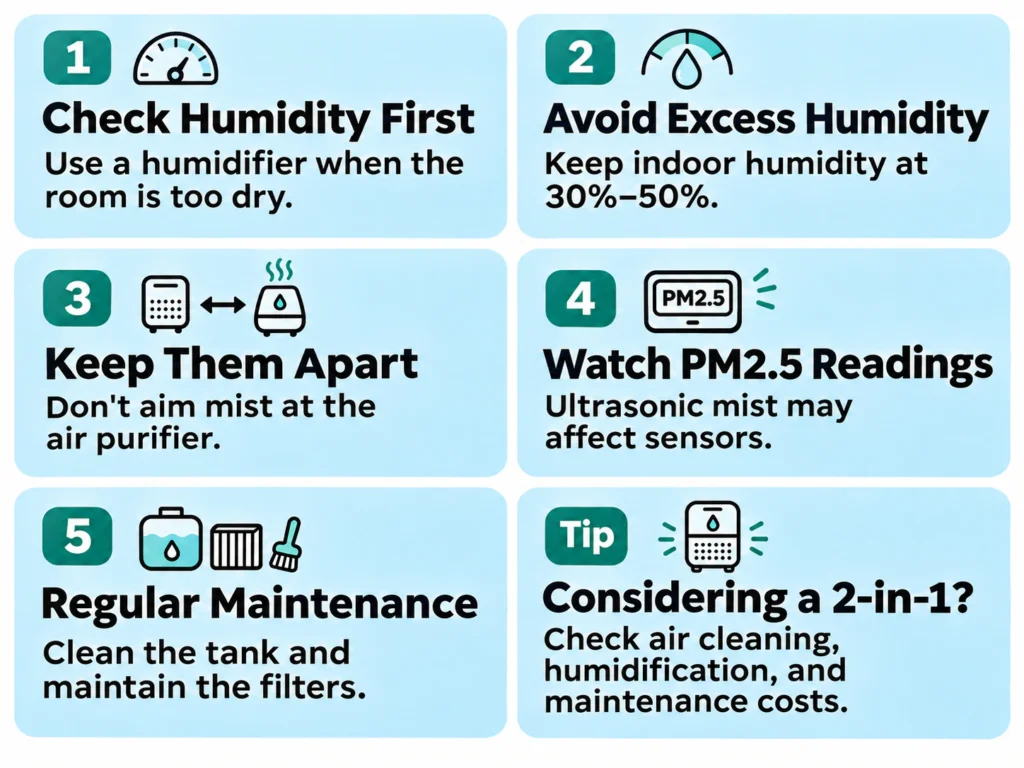
Tip: There are also 2-in-1 air purifier–humidifier units on the market. However, I’d be hesitant to recommend choosing one just to save space. Before buying, pay particular attention to its air purification performance, humidification capacity, and maintenance costs.
Frequently Asked Questions
Health Disclaimer: This article is for general informational purposes only and is not a substitute for professional medical advice. If you have persistent allergy, cough, or breathing symptoms, consult a qualified healthcare professional.