Best Sleeping Bag Liners of 2026: Picks for Warmth, Travel, and Backpacking
We may earn a commission from affiliate links to products on this page, at no additional cost to you. Learn more
Introduction
On a backpacking trip, you may want a little more warmth from the sleeping bag you already own without replacing an expensive bag just for a few degrees. Travel and hostel stays create a different problem: sometimes you simply want a clean, easy-to-wash layer between you and shared bedding.
A sleeping bag liner sits right between those two needs. It can add warmth while helping keep your sleeping bag cleaner, which can reduce how often the bag itself needs to be washed and help extend the life of your core sleep gear.
To build this 2026 list of the best sleeping bag liners, we cross-checked official brand specifications with current Amazon US market signals. For products with enough low-star feedback to be useful, we also focused on 3-star and 1-star reviews to identify problems that came up repeatedly in real use. We did not treat a brand’s “up to” warmth claim as a standardized sleeping bag temperature rating, and we did not choose products based on star scores alone.
Quick Picks: Best Sleeping Bag Liners at a Glance
| Best For | Product | Material | Weight | Shape | Why It Stands Out |
|---|---|---|---|---|---|
| Best Fleece for Warmth | Litume All Season Fleece | Fleece (polyester) | 17.9 oz | Mummy | Clear warmth-first design with substantial market feedback |
| Best Synthetic for Warmth | Sea to Summit Reactor Extreme | Synthetic (Thermolite) | 12.8 oz | Mummy | Lighter than thick fleece, with more stretch and adjustability |
| Best Silk for Travel | BROWINT Silk | 100% mulberry silk | 6.3 oz | Rectangular | Pure silk, roomy dimensions, and a travel-focused design |
| Best for Travel / Hostels | The Friendly Swede Microfiber | Polyester microfiber | 17.6 oz | Rectangular | Well-established hostel/hotel use with 2,000+ Amazon ratings |
| Best Budget | WILLNORN | Polyester microfiber | 18 oz | Rectangular | Very low price and enough features for basic travel-hygiene needs |
| Best Ultralight | Frelaxy Ultralight | Polyester | 6.9 oz | Rectangular | Very low weight for warm-weather backpacking and light travel |
Sleeping Bag Liner Comparison
Price tiers in this guide: Budget ≤ $25; Mid-range $25–$60; Premium > $60. Actual prices can change, so check the current Amazon page before buying.
| Product | Best For | Material | Weight | Shape | Price Tier | Main Trade-Off |
|---|---|---|---|---|---|---|
| Litume Fleece | Fleece warmth | Fleece | 17.9 oz | Mummy | Mid-range | Heavier and bulkier; some sleepers find the fit restrictive |
| STS Reactor Extreme | Synthetic warmth | Thermolite | 12.8 oz | Mummy | Mid-range | Generation/variant naming can be confusing; feedback sample is moderate |
| BROWINT Silk | Travel silk | 100% silk | 6.3 oz | Rectangular | Premium | 8 Momme fabric is thin and has little stretch |
| Friendly Swede | Travel / hostels | Microfiber | 17.6 oz | Rectangular | Mid-range | Not lightweight; slick fabric can twist around some sleepers |
| WILLNORN | Budget | Polyester | 18 oz | Rectangular | Budget | Thin fabric and some zipper-durability concerns |
| Frelaxy | Ultralight | Polyester | 6.9 oz | Rectangular | Budget | Narrower fit; no zipper makes entry and exit less convenient |
How We Chose These Sleeping Bag Liners
This list is not just a spec sheet. Before choosing the final six sleeping bag liners, we focused on the following factors:
Official specs and materials: We checked product weight, packed size, and the characteristics of the actual fabric used.
Real-world market feedback: In addition to looking at Amazon’s overall rating signals and rating volume, we read 3-star and 1-star feedback when enough low-star comments were available, looking for problems that appeared repeatedly in actual use.
Product differentiation: When two products overlapped heavily, we kept the one with stronger market evidence or a clearer reason to buy.
Amazon ratings, rating counts, recent-purchase labels, and availability reflect what we saw during our October 2026 research and may change over time.
The 6 Best Sleeping Bag Liners of 2026
1. BEST FLEECE FOR WARMTH
Litume All Season Fleece Sleeping Bag Liner
Quick Specs:
Why It Fits:
If you want a sleeping bag liner for warmth, Litume is one of the most clearly warmth-focused traditional fleece options in our shortlist. It has more than 800 Amazon ratings, the anti-pill fleece feels soft against the skin, and the hood and drawstring help reduce heat loss around the head. A compression sack is included.
What to Consider:
As a fleece sleeping bag liner, it is relatively heavy at 17.9 oz and takes up more room than an ultralight liner, so it is not aimed at strict weight-cutters. Some of the lower-rated feedback we reviewed also said the real warmth increase felt well below the brand’s 27°F claim. The mummy shape can feel restrictive if you move around a lot at night.
Best For: Campers who want traditional fleece warmth in colder conditions and are willing to carry roughly an extra pound.
Skip If: Strict ultralight users, or restless sleepers who dislike a close-fitting liner.
2. BEST SYNTHETIC FOR WARMTH
Sea to Summit Reactor Extreme Sleeping Bag Liner
Quick Specs:
Why It Fits:
This is one of the most feature-rich technical synthetic liners in the group. Its Thermolite Pro stretch-knit fabric gives you more room to move inside a mummy sleeping bag, while shoulder/arm openings and a drawcord footbox add ventilation and flexibility. It also uses HeiQ Fresh odor-control treatment.
What to Consider:
As a thermal sleeping bag liner, the main complication is version naming: older and newer Reactor variants can differ slightly in weight and configuration. The Amazon listing had 112 ratings during our research, with strong recent purchase activity, but that is still a smaller feedback base than the long-running travel liners. It also costs more than budget options and does not provide one fixed warmth-addition figure.
Best For: Three-season or cold-weather hikers who want a more technical balance of weight, warmth, stretch, and adjustability.
Skip If: Shoppers who want one standardized warmth number, or anyone who would rather avoid version/variant confusion.
3. BEST SILK LINER FOR TRAVEL
BROWINT Silk Sleeping Bag Liner
Quick Specs:
Why It Fits:
If you are looking for a silk sleeping bag liner, BROWINT has one of the strongest market records among the pure-silk options we researched. It had more than 425 Amazon ratings, and the page showed “50+ bought in past month” during our check. The XL cut is extremely roomy, the mulberry silk feels soft against the skin, and the pillow pocket plus reinforced gussets make it especially practical for hotels and hostels.
What to Consider:
The 8 Momme fabric is thin, and some users felt the hand-feel did not match what they expected at a premium price. It has little stretch, so frequent movers may find the fabric clings or makes entry and exit less convenient. The brand says it can be machine washed, but silk still calls for gentler care than a basic synthetic liner.
Best For: Travelers, hotel guests, and hostel users who want a roomy pure-silk sleep layer and do not need significant extra warmth.
Skip If: Anyone who needs a noticeable thermal boost, or restless sleepers who want a stretchy, unrestricted liner.
4. BEST FOR TRAVEL AND HOSTELS
The Friendly Swede Microfiber Sleeping Bag Liner
Quick Specs:
Why It Fits:
Among the sleeping bag liners in this guide, this one has the deepest track record for travel-hygiene use, with more than 2,200 Amazon ratings during our research. The full-length two-way side zipper makes entry and exit very easy, and the liner can open out flat like a travel sheet. The built-in pillow pocket also makes sense for hostels, budget hotels, and Airbnb stays.
What to Consider:
At 17.6 oz, it is not a lightweight backpacking choice. The microfiber feels slicker than silk or fleece, and some users said it can twist around the body or feel clammy in warm conditions. Think of it primarily as a comfortable travel barrier rather than a serious warmth upgrade.
Best For: Hostel, hut, and hotel travelers who want a roomy, washable personal layer between themselves and shared bedding.
Skip If: Backpackers who dislike slick microfiber or who want very low weight and a noticeable thermal boost.
5. BEST BUDGET
WILLNORN Sleeping Bag Liner
Quick Specs:
Why It Fits:
During our research, WILLNORN sat in the lowest price tier of this group while still carrying nearly 1,000 Amazon ratings (962 at the time we checked). Its appeal is straightforward: it is inexpensive, reasonably roomy, easy to wash, and useful for warm-weather trips or hostel stays. The side zipper lets it open out into a larger travel-sheet-style layer.
What to Consider:
The low price comes with trade-offs. In the low-star feedback we reviewed, thin fabric and zipper durability came up repeatedly, including reports of zipper failure or tearing early in use. Do not buy it expecting a meaningful thermal upgrade; it is better understood as a basic protective layer.
Best For: Budget-focused travelers who mainly want a hostel hygiene layer or an occasional warm-weather camping sheet.
Skip If: Anyone who needs noticeable warmth or expects premium stitching and long-term heavy-duty use.
6. BEST ULTRALIGHT
Frelaxy Ultralight Sleeping Bag Liner
Quick Specs:
Why It Fits:
If you are looking for a lightweight sleeping bag liner or an ultralight sleeping bag liner, Frelaxy fills the low-weight gap in this lineup. During our research it held the #1 position in the Camping Sleeping Bag Liners category, and the Amazon page showed “50+ bought in past month.” It is very light, quick-drying, and includes a pillow sleeve, which makes it a strong fit for warm-weather fast-and-light trips or minimalist travel.
What to Consider:
The Amazon listing had about 241 ratings during our research, so the feedback base is still relatively small. The no-zip design can also make entry and exit less convenient, and Amazon metadata showed conflicting width information across variants. Confirm the exact width before buying.
Best For: Weight-conscious warm-weather backpackers and minimalist travelers who want a very light personal sleep layer.
Skip If: Shoppers who need noticeable warmth, prefer a roomy liner, or only buy products with a long high-rating history.
Which Sleeping Bag Liner Fits Your Trip?

If you are still deciding after the detailed reviews, narrow it down by the kind of trip you are actually planning:
If warmth is your priority: choose Litume for traditional fleece warmth, or the Sea to Summit Reactor Extreme for a lighter synthetic approach.
For backpacking or ultralight use: choose the Sea to Summit Reactor Extreme when you want a better balance of warmth and weight, or Frelaxy when maximum weight savings matter more.
For hostels and travel: choose The Friendly Swede for a mature, practical travel design, or BROWINT for the comfort of pure silk.
If budget is the main constraint: choose WILLNORN.
What to Look for in a Sleeping Bag Liner
1. Materials
Silk: A silk sleeping bag liner is the lightest and most compact option, with an excellent next-to-skin feel. Warmth is limited, and durability in very thin silk depends on fabric weight and construction.
Synthetic / Thermolite: A thermolite sleeping bag liner offers the best warmth-to-weight ratio in this material group, dries quickly, usually has some stretch, and works across a wide range of trips.
Fleece: A fleece sleeping bag liner is warm and soft, but it is heavier and bulkier, which makes it better for colder trips where weight is not the first priority.
Cotton: A cotton sleeping bag liner is comfortable, inexpensive, and easy to wash, but it is heavy and slow to dry. It is better suited to hostels, huts, or car camping than backpacking.
Merino wool: A merino wool sleeping bag liner offers excellent temperature regulation and odor control and performs well in damp conditions, but it is expensive and heavy, and strong product options are less common.
2. Shape: Mummy vs. Rectangular
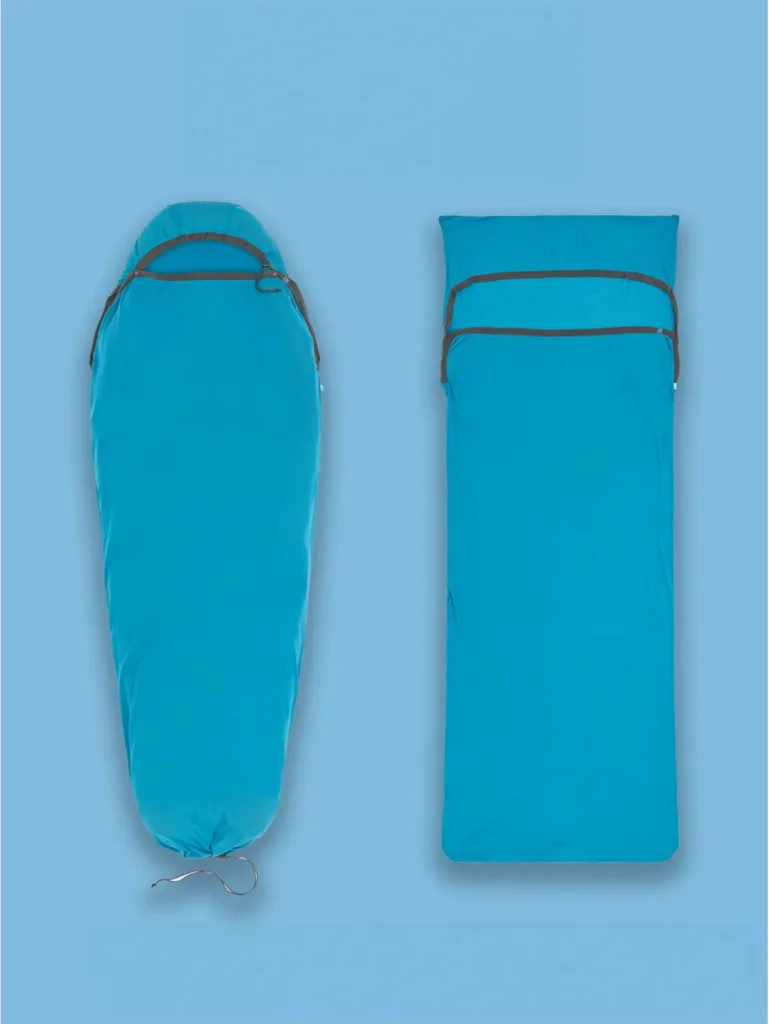
Mummy: A mummy sleeping bag liner usually works better inside a mummy sleeping bag because there is less excess fabric and the liner stays tidier around the body.
Rectangular: A rectangular liner gives you more room and works well on its own or in hostels. Inside a narrow mummy bag, however, extra fabric can bunch up and reduce comfort.
3. Weight and Packed Size
A 17–28 oz liner and a 5–7 oz liner are built for very different users. Car camping and hostel travel can tolerate more weight, while long-distance backpacking changes the equation completely. If you are also trying to reduce the weight of the rest of your sleep system, compare a lighter backpacking sleeping bag as well.
4. Brand Warmth Claims
A brand’s “up to X°F” claim can help you understand how the product is positioned, but it is not a standardized sleeping bag temperature rating. Real-world warmth also depends on the sleeping bag, sleeping pad, fit, humidity, and the individual sleeper. If you are unsure what temperature range your bag itself should cover, start with choosing the right sleeping bag temperature rating. Do not expect a liner to turn a summer bag into a winter sleep system.
5. Useful Features
Useful features include a hood or drawstring to reduce open space around the head, a pillow pocket for hostels and travel, a foot opening for temperature control, stretch for easier movement, and insect-repellent treatments for specific travel environments.
Do You Need a Sleeping Bag Liner?
Worth bringing when:
You want to reduce how often you wash an expensive sleeping bag.
You want a small warmth boost in spring or fall.
You are staying in hostels or huts and want your own personal sleep layer.
You want a light standalone layer for warm summer nights.
You may be better off leaving it behind when:
You are counting every ounce in a strict ultralight setup.
Your sleeping bag already gives you enough margin for the lowest nighttime temperature you expect.
You are only trying to force an under-insulated bag into winter conditions. A liner is not a substitute for a sleeping bag designed for colder conditions.
How to Wash and Care for a Sleeping Bag Liner
Always follow the care label for your exact liner first.
Silk: Most silk liners call for a cold, gentle hand wash or delicate machine cycle, followed by air-drying away from direct sun and high heat.
Synthetic / fleece: Many liners can be machine washed, but some brands specifically advise against fabric softener or bleach, so the care label for the exact product still takes priority.
How often to wash: There is no need to follow a rigid every-two-or-three-trips rule. Let sweat, dirt, and travel conditions determine when it needs cleaning; after a long trip, washing the liner is usually a good idea. If the sleeping bag itself needs cleaning, see our guide to washing a sleeping bag.
Sleeping Bag Liner FAQ
Q: What is the best sleeping bag liner?
A: It depends on your priority. Choose Litume for fleece warmth, the STS Reactor Extreme for lighter synthetic warmth, The Friendly Swede for travel hygiene, and Frelaxy when ultralight weight matters most.
Q: What is the warmest sleeping bag liner?
A: Fleece and thicker insulated synthetic liners are usually the warmest categories, but brand warmth claims are not standardized temperature ratings, so the real effect varies by user and sleep system.
Q: How much warmth can a sleeping bag liner add?
A: Silk adds very little warmth, while fleece can add roughly 10–20°F of perceived warmth. Treat any brand claim as a best-case reference rather than a standardized temperature rating.
Q: Can you sleep in a sleeping bag liner by itself?
A: Yes, in a warm indoor setting such as a hostel or on a warm summer night. Whether it is comfortable on its own depends on the liner material and the conditions that night.
Q: Can a sleeping bag liner stop bed bugs?
A: A standard liner cannot guarantee protection from bed bugs. Fabrics treated with an insect-repellent technology such as Insect Shield® can provide a repellent effect.
A sleeping bag liner is a relatively simple way to keep your sleeping bag cleaner, add comfort, or fine-tune your sleep system—as long as the material and weight match the way you actually travel. We hope this guide helps you find the right one for your trips.