Best Portable Power Stations: 10 Picks for Home Backup, Camping & More

We may earn a commission from affiliate links to products on this page, at no additional cost to you. Learn more
Modern smart electronic devices and household appliances have become an essential part of our daily lives. But these electronic devices still face a problem that’s hard to overcome: their batteries don’t hold enough charge to keep them running for long periods. Household appliances face a different problem: when the power goes out, they stop working altogether.
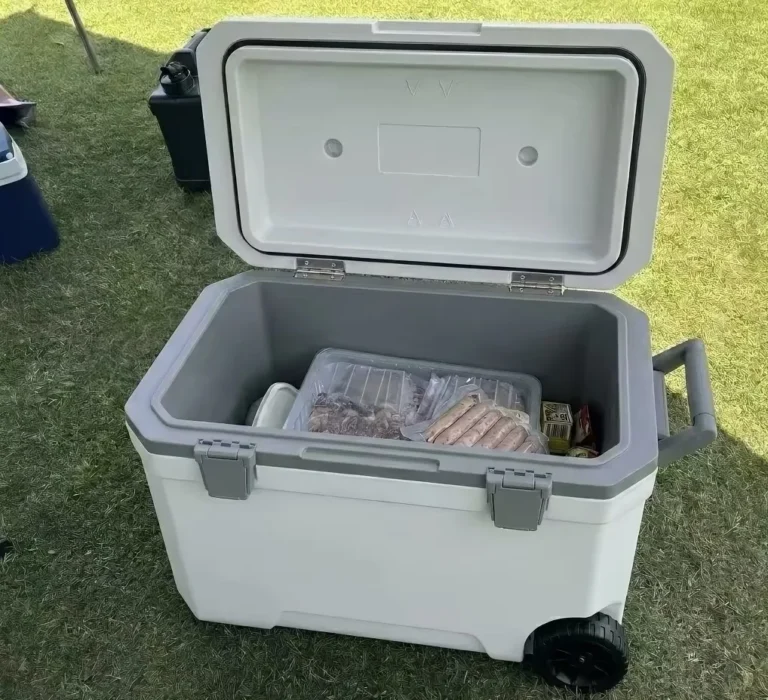
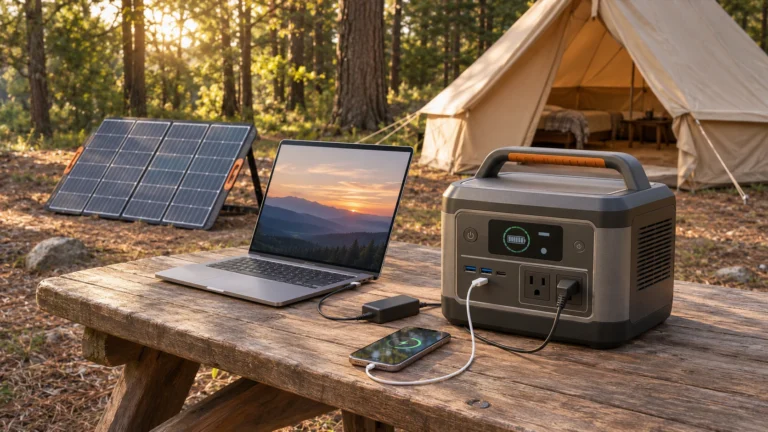
Imagine you’re working outdoors, enjoying the beauty of nature, when your computer or phone suddenly gives you a low-battery warning. Or you’ve just finished a big grocery shopping trip over the weekend and filled your fridge with dairy products and meat, only to have the power suddenly go out. Just think how awful that would be! That’s when having a portable power station becomes a real necessity. It can take away all those worries.
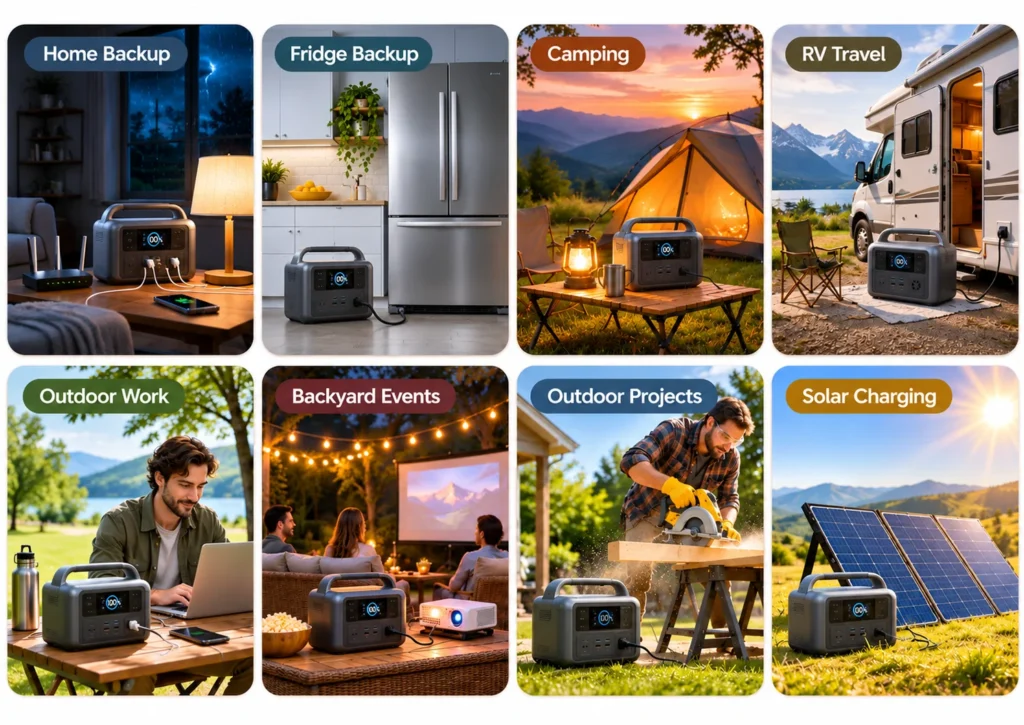
Many people are looking for the best portable power station, but the type you should buy really depends on how you plan to use it. There are so many portable power stations on the market, and battery capacity, power output, charging methods, and prices vary widely across brands and models. Finding one that truly fits your needs isn’t easy.
That’s why I’ve drawn on my own everyday experience, reviewed and compared information on dozens of models, and considered customer reviews and feedback from buyers who have used them. Below, I’ll share a few portable power stations worth considering, explain their strengths. I hope this saves you time comparing one product after another.
Find the Best Portable Power Station: Side-by-Side Comparison
When choosing a portable power station, consider not only whether it fits your intended use but also how its key specifications compare. I’ve put several models side by side below so you can see the differences at a glance and find one that better suits your needs.
|
Product |
Best For |
Capacity (Wh) |
AC Output (W) |
Weight (lb) |
|---|---|---|---|---|
|
BLUETTI Elite 30 V2 |
Short Trips & Light Camping |
288Wh |
600W |
9.5 lb |
|
Jackery Explorer 300 |
Off-Grid Device Charging |
293.8Wh |
300W |
7.1 lb |
|
Anker SOLIX C1000 Gen 2 |
Higher-Power Everyday Use |
1,024Wh |
2,000W |
24.9 lb |
|
EcoFlow DELTA 3 |
Everyday Use & Short-Term Backup |
1,024Wh |
1,800W |
27.6 lb |
|
Jackery Explorer 1000 v2 |
Weekend Camping & RV Trips |
1,070Wh |
1,500W |
23.8 lb |
|
BLUETTI Elite 100 V2 |
Camping & Solar Recharging |
1,024Wh |
1,800W |
25.3 lb |
|
Anker SOLIX S2000 |
Longer Runtime & Essential Backup |
2,010Wh |
1,500W |
35.7 lb |
|
BLUETTI Elite 200 V2 |
High-Output Outdoor Power |
2,073.6Wh |
2,600W |
53.4 lb |
|
BLUETTI Elite 300 |
Essential Home Backup |
3,014.4Wh |
2,400W |
58 lb |
|
Anker SOLIX F3000 + 400W Solar Kit |
Expandable Solar Home Backup |
3,072Wh |
2,400W / 3,600W (TT-30) |
91.5 lb |
Weights are for the power station only; solar panels and other accessories are not included.
Our Portable Power Station Picks for Different Needs
Best Small Portable Power Stations for Short Trips
Best Compact Power Station
for Short Trips

BLUETTI Elite 30 V2 Portable Power Station
🔋 288Wh LFP Battery:
600W continuous AC output
🎒 Lightweight Design:
Just 9.5 lb
☀️ Solar & Fast Charging:
Up to 200W solar input; 0–80% in 45 min (Turbo AC)
Buying Advice
Why It Works
The BLUETTI Elite 30 V2 is worth considering because it packs a good range of features into a compact unit. It has two AC outlets and a 140W USB-C port that can charge compatible laptops. Its 600W output also lets it power small appliances whose power requirements fall within that limit.
I also value its long-lasting lithium iron phosphate (LFP) battery, fast AC charging, and the BLUETTI app, which lets you monitor power consumption and adjust settings. For camping trips away from electrical outlets, you can also choose the 100W solar panel kit for another way to recharge.
Keep in Mind
The 288Wh battery is better suited to charging devices and providing short-term power. It isn’t suitable for running power-hungry appliances continuously for hours. Although it supports 1,500W Power Lifting mode, that isn’t its continuous output rating, and the mode is only suitable for certain resistive loads.
This model also doesn’t have a built-in light. When you’re not using the AC or DC outputs, remember to turn them off to avoid unnecessary battery drain.
Best for Off-Grid Charging

Jackery Explorer 300 Portable Power Station
🔋 293.8Wh Battery:
300W continuous AC output
🎒 Lightweight Design:
Just 7.1 lb
🔌 Multiple Charging Ports:
Two AC outlets and 60W USB-C PD
Buying Advice
Why It Works
The Jackery Explorer 300 is a compact power station with a clear purpose. When you’re out and can’t find a power outlet, or when there’s a temporary power outage, your phone, laptop, camera, and other devices still need charging. With its built-in handle and a weight of just 7.1 lb, you don’t have to haul a bulky, high-capacity power station just to charge these smaller devices. Its two pure sine wave AC outlets, 60W USB-C port, and other USB ports also give you more options for charging different devices.
Its recharging options are flexible, too, which is another point worth considering. You can recharge it from a wall outlet at home, a car’s power outlet while driving, or a compatible solar panel when you’re outdoors. If you want to recharge it faster, you can also use the AC charger and USB-C input at the same time. These features are practical for short outdoor trips or temporary power outages.
Keep in Mind
This power station has a continuous AC output of just 300W, so it isn’t suitable for high-wattage appliances such as coffee makers or space heaters. Its 293.8Wh battery capacity is also fairly limited, making it better suited to recharging electronic devices than powering appliances continuously for long periods.
Recharging from a wall outlet alone takes about 4.5 hours, which isn’t particularly fast. It also has no built-in light, and its battery capacity can’t be expanded with an additional battery. The original version uses an NCM lithium-ion battery rather than a lithium iron phosphate (LFP) battery, which is another point worth keeping in mind before buying.
Best Portable Power Stations for Everyday Use
Best for Higher Power Needs

Anker SOLIX C1000 Gen 2 Portable Power Station
🔋 1,024Wh LFP Battery:
2,000W continuous AC output
⚡ 49-Minute Fast Charging:
Enable HyperFlash mode through the Anker app
🔌 10 Output Ports:
Five AC outlets and two 140W USB-C ports
Buying Advice
Why It Works
Besides charging phones and computers, this portable power station can also handle some higher-wattage household appliances. With 2,000W of continuous AC output, it can temporarily power appliances such as coffee makers and electric kettles, provided their power requirements are within its limits. Five AC outlets and two USB-C ports rated at up to 140W each also make it convenient to connect different devices at the same time. Despite its 1,024Wh battery capacity, it weighs about 24.9 lb, making it easier to move than many power stations in the same capacity class.
It also supports fast charging. If you’re getting ready to head out at short notice or need to recharge after a power outage, you can enable HyperFlash fast-charging mode through the Anker app. Under the specified charging conditions, Anker says it can fully recharge in about 49 minutes. It also supports up to 600W of solar input and a UPS transfer time of about 10 milliseconds during a power outage. These features are practical for households that need temporary backup power.
Keep in Mind
Although it can deliver 2,000W of continuous output, its 1,024Wh battery doesn’t mean it can keep high-power appliances running for long periods. Actual runtime depends on how much power the connected devices draw.
Best Overall for Everyday Use

EcoFlow DELTA 3 Portable Power Station
🔋 1,024Wh LFP Battery:
1,800W continuous AC output
🔌 13 Output Ports:
Six AC outlets and two 100W USB-C ports
⚡ Fast Charge & Expansion:
About 56 min via AC; supports compatible expansion batteries.
Buying Advice
Why It Works
If I were choosing a portable power station for both everyday household use and short power outages, I’d pay close attention to its output power, number of ports, and flexibility. The EcoFlow DELTA 3 offers a good balance in these areas. With six AC outlets and two USB-C ports rated at up to 100W each, it can power a router, computer, lights, or other essential appliances during a temporary outage, depending on their power requirements, without having to constantly switch between connected devices.
One feature that makes it especially worth considering is the option to expand its battery capacity as your needs change. Although the main unit has only 1,024Wh of capacity, it can connect to compatible expansion batteries, with EcoFlow offering expansion options up to approximately 5kWh. If you need longer home backup runtime in the future, you may not have to replace the entire setup. It also supports up to 500W of solar input and can recharge fully from AC power in about 56 minutes. Through the EcoFlow app, you can check the battery level and monitor power input and output, making everyday management more convenient.
Keep in Mind
The 1,024Wh figure is the battery’s rated capacity, not necessarily the amount of usable energy you’ll get through the AC outlets. If you plan to run a refrigerator or other appliances during a power outage, it’s best to check their running wattage and estimate how long the power station can run them rather than relying on battery capacity alone.
Also, only three of the six AC outlets are grounded, so appliances that require grounding should use the appropriate outlets. At about 27.6 lb, this unit isn’t especially lightweight, and expansion batteries and solar panels must be purchased separately.
Best Portable Power Stations for Camping & RV Trips
Best for Weekend Camping

Jackery Explorer 1000 v2 Portable Power Station
🔋 1,070Wh LFP Battery:
1,500W continuous AC output
🎒 Portable & Easy to Store:
About 23.8 lb with a folding handle
💡 Camping-Friendly Design:
Three AC outlets and a built-in light
Buying Advice
Why It Works
The Jackery Explorer 1000 v2 weighs about 23.8 lb. With its folding handle tucked away, it’s relatively easy to fit into a car trunk. It has a 1,070Wh lithium iron phosphate (LFP) battery and 1,500W of continuous AC output. As long as the devices’ power requirements are within its limits, it can power a camping fridge, lights, a laptop, and other equipment, so you don’t have to bring a bulkier, high-capacity power station just for these everyday camping needs.
Another reason it’s worth considering is how straightforward it is to use. Its three AC outlets, along with USB-C, USB-A, and a 12V car outlet, can meet the power needs of different devices. It also runs relatively quietly, so fan noise is less likely to disturb you at a campground at night. There’s a built-in light, too, which comes in handy when you need to check the unit or look for something.
Keep in Mind
This model has only three AC outlets, and they’re spaced fairly close together. If you plug in several bulky power adapters at once, they may block one another. Regular AC charging also takes about 1.6–1.7 hours. The advertised roughly one-hour full recharge requires enabling emergency fast-charging mode through the app; it isn’t the default charging speed.
If you’re planning to rely mainly on solar charging at your campsite, keep in mind that the maximum solar input is 400W, and reaching that limit requires using both input ports. Each port supports up to 200W. Solar panels must be purchased separately, and actual charging speed also depends on sunlight conditions and the panel configuration.
Best for Solar Recharging

BLUETTI Elite 100 V2 Portable Power Station
☀️ Up to 1,000W Solar Input:
Built-in MPPT solar charge controller
🔋 1,024Wh LFP Battery:
1,800W continuous AC output
🔌 11 Output Ports:
Four AC outlets and a USB-C port rated at up to 140W
Buying Advice
Why It Works
If you’re planning to camp outdoors for several days, it’s worth thinking about how you’ll recharge your power station during the day, not just how much energy it can store. The BLUETTI Elite 100 V2 supports up to 1,000W of solar input. For a portable power station with only 1,024Wh of capacity, that’s an appealing input limit. It has a built-in MPPT solar charge controller. With properly matched solar panels and good sunlight, you may be able to replenish the battery relatively quickly during the day and rely less on campground power outlets.
It also offers solid power capabilities. With 1,800W of continuous AC output and 11 output ports, it can power multiple devices at once, provided their power requirements are within the unit’s limits. The U.S. version has four AC outlets and a USB-C port rated at up to 140W, making it convenient to charge laptops and other devices. It uses a lithium iron phosphate (LFP) battery, and BLUETTI states that it can retain about 80% of its original capacity after more than 4,000 charge-discharge cycles. The BLUETTI app also lets you monitor charging and discharging and adjust settings.
Keep in Mind
One important thing to keep in mind is that the 1,000W solar input rating is only the maximum power this unit can accept. It doesn’t mean you’ll automatically get that charging rate when you connect solar panels. It has just one solar input port, supporting a voltage range of 12–60V and a maximum current of 20A. Before buying solar panels, check their open-circuit voltage, wiring configuration, and connector compatibility. In particular, don’t connect multiple panels in series without first checking whether the configuration meets the unit’s specifications. Actual solar charging power also depends on the weather and panel setup.
Also, the power station alone doesn’t include solar panels, so you’ll need to purchase them separately. Its ports don’t have waterproof protective covers, so protect the unit from rain and moisture when using it outdoors. Although it runs relatively quietly under light loads, the cooling fans may become noticeably louder at higher loads.
Best 2kWh Portable Power Stations for Extended Use
Best Lightweight 2kWh Option

Anker SOLIX S2000 Portable Power Station
🔋 2,010Wh LFP Battery:
1,500W continuous AC output
🎒 Compact 2kWh Design:
Weighs about 35.7 lb and has five AC outlets
⚡ Low Idle Power & Fast Transfer:
About 6W active idle power draw; UPS transfer time of 10 ms or less
Buying Advice
Why It Works
The Anker SOLIX S2000 is worth considering for more than just its roughly 2kWh battery capacity. It also helps reduce unnecessary power consumption by the power station itself. When a refrigerator’s compressor cycles on and off, this low idle power draw can help make the stored energy last longer.
I also like the balance it strikes between capacity and size. At 35.7 lb, it’s relatively lightweight for a power station in the 2kWh class, and you don’t need to clear out much storage space for it. It’s a practical option to bring out during a power outage to power a refrigerator, router, and essential lighting, or to take along on a camping trip.
Keep in Mind
This power station prioritizes runtime over high power output. Its 1,500W continuous output isn’t suitable for running several power-hungry appliances at once, and you can’t expand its capacity with an additional battery. If you plan to rely on solar charging for extended periods, its 400W solar input limit is also worth considering.
Although the unit is fairly compact, the recessed handle isn’t particularly convenient for carrying it with one hand. If you frequently need to lift it into and out of your vehicle, that could affect how convenient it is to handle.
Best for High-Output Outdoor Power

BLUETTI Elite 200 V2 Portable Power Station
🔋 2,073.6Wh LFP Battery:
2,600W continuous AC output
🔌 9 Output Ports:
Four AC outlets and two 100W USB-C ports
☀️ Up to 1,000W Solar Input:
Supports solar recharging outdoors
Buying Advice
Why It Works
When you’re working outdoors, the biggest hassle isn’t the lack of a power outlet—it’s bringing along a power station only to discover it can’t run the equipment you need. The BLUETTI Elite 200 V2’s 2,600W continuous output is the main reason I’d recommend it. Whether you’re working on a project in the yard, using power tools in a shed, or powering certain high-wattage appliances while camping, it gives you more power headroom as long as the equipment’s power requirements are within its limits.
Another advantage worth considering is its flexibility for recharging outdoors. In addition to AC charging, it supports up to 1,000W of solar input. If you’re planning to spend several days without access to grid power and don’t want to rely entirely on the energy stored before your trip, pairing it with compatible solar panels can be more practical. Four AC outlets and multiple USB ports also make it easier to connect different devices.
Keep in Mind
High output doesn’t mean unlimited runtime. Power-hungry appliances will still drain the battery quickly. At about 53.4 lb, this unit is also heavy and isn’t protected against rain. It’s better suited to staying in one place than being moved around frequently outdoors.
There’s one other thing to watch for: the default ECO mode may automatically shut off the output when the load is low. If you need continuous power for a refrigerator, lights, or other essential devices, check the relevant settings before use. The advertised 3,900W Power Lifting mode isn’t its continuous output rating, either, so don’t treat it as a standard 3,900W power station.
Best 3kWh Portable Power Stations for Home Backup
Best 3kWh Backup for Home Essentials

BLUETTI Elite 300 Portable Power Station
🔋 3,014.4Wh LFP Battery:
2,400W continuous AC output
🎒 Compact 3kWh Design:
Main unit weighs about 58 lb and has a relatively compact footprint
🔌 Multi-Device Backup Power:
Four AC outlets and UPS transfer time of 10 ms or less
Buying Advice
Why It Works
With about 3kWh of capacity and a variety of output ports, the BLUETTI Elite 300 is especially well suited to backup power needs focused on essential household devices. Its relatively compact design also makes it easier to find a suitable place to store it when not in use.
Keep in Mind
One easy-to-miss distinction is that it can deliver up to 2,400W when running on battery power, but when it’s plugged into a household outlet and operating in bypass mode, the limit drops to just 1,800W. The AC outlets are also spaced fairly close together, so a bulky power adapter could block the outlet next to it. And because this model doesn’t support expansion batteries, your options for increasing capacity later are limited.
Best Expandable 3kWh Solar Backup
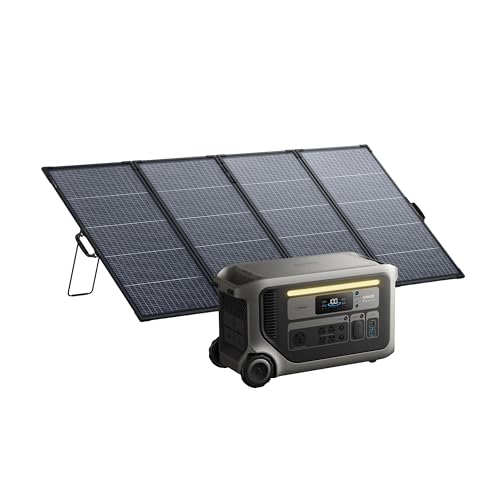
Anker SOLIX F3000 Portable Power Station + 400W Solar Panel Kit
🔋 3,072Wh LFP Battery:
Up to 3,600W continuous AC output (via the TT-30 outlet)
☀️ 400W Solar Kit:
Includes a bifacial solar panel
🔗 Expandable Battery System:
Supports compatible expansion batteries
Buying Advice
Why It Works
When a power outage drags on, my biggest concern is what to do when the battery starts running low. The Anker SOLIX F3000 kit already comes with a 400W solar panel, so you can recharge the battery when there’s sunlight. It also supports powering essential household devices while the battery is charging.
It also leaves room for upgrades later. You can start with the 3kWh-class main unit now, then add compatible expansion batteries if you need longer backup runtime in the future, without having to replace the entire system.
Keep in Mind
The kit only includes a 400W solar panel. The 2,400W figure is the main unit’s maximum supported solar input, not the charging power this kit provides as sold. At around 91.5 lb, the power station is still difficult to carry upstairs. Also, the regular AC outlets have a combined output limit of 2,400W. To get 3,600W of output, you need to use the TT-30 outlet, and a single unit does not provide 240V power.
For more portable power station comparisons, read EcoFlow DELTA 3 vs. DELTA 3 Classic: Which Portable Power Station Is Right for You?.
What to Look for in a Portable Power Station
1. Battery Chemistry
When choosing a portable power station, I recommend prioritizing models that use lithium iron phosphate (LiFePO4 / LFP) battery cells. Compared with common nickel manganese cobalt (NMC) lithium-ion batteries, LFP batteries generally offer better thermal stability, longer cycle life, and a relatively better safety profile. The U.S. Department of Energy’s Energy Storage Safety Strategic Plan also discusses these advantages.
Although some models may cost more overall, I still think they’re worth prioritizing for their long-term safety and reliability. However, LFP batteries typically have lower energy density, so power stations with the same battery capacity may also be heavier.
2. Pure Sine Wave Inverter
I recommend choosing a portable power station with a pure sine wave inverter. Its AC output waveform is closer to household utility power, offering better compatibility with electronic devices such as laptops and TVs, as well as some motor-driven household appliances.
Modified sine wave inverters may be less expensive, but they can cause excess heat, noise, or operating problems with certain appliances. In severe cases, they may even damage the equipment. Renogy’s technical guide also explains how these two waveforms can affect appliances differently. So, besides checking the output power, make sure to verify the inverter’s waveform and whether its output voltage meets your devices’ requirements.
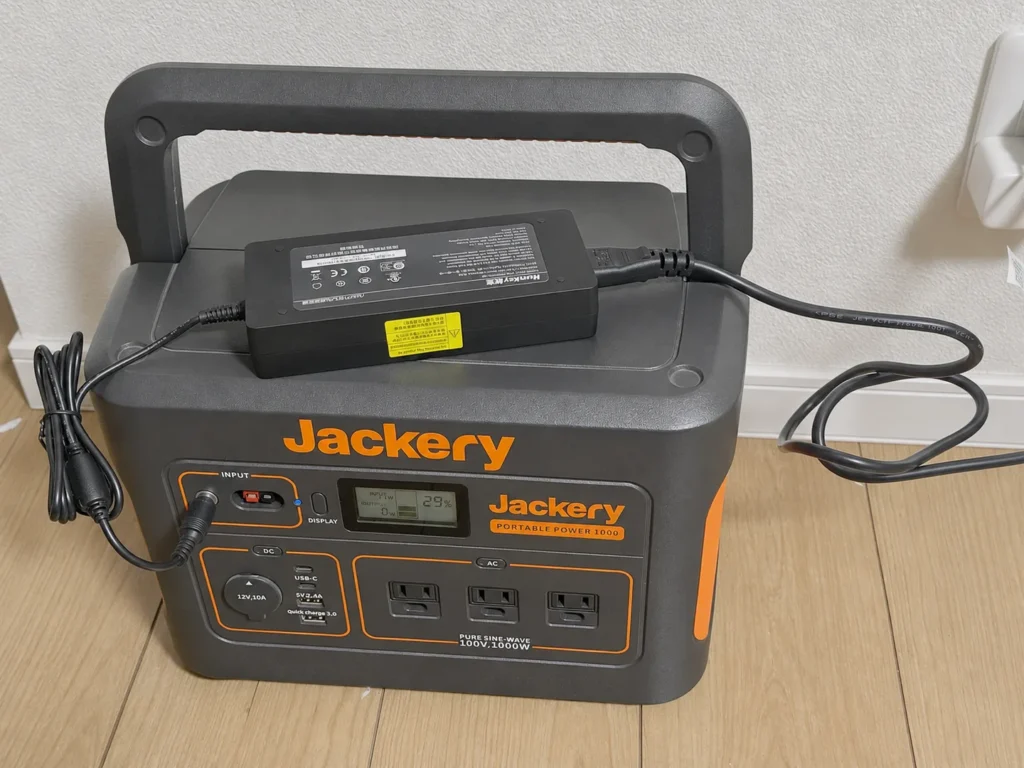
3. Battery Management System (BMS)
The battery management system is like the “brain” of a portable power station and is also an important part of its safety protection. It monitors battery voltage, current, and temperature, working with protective circuits to help prevent risks such as overcharging, overdischarging, overcurrent, overheating, and short circuits.
When shopping, don’t just look for “BMS” in the product description. Also check whether the brand clearly lists the protection features it provides. A well-designed battery management system and overall protection system are important safeguards for safe long-term use. UL Research Institutes’ battery safety information also notes that overcharging, short circuits, and abnormal temperatures can trigger battery thermal runaway.
4. Safety Certifications
Safety certifications are another important factor to consider when choosing a portable power station. This is especially true for units used as home backup power, which may remain connected to appliances such as refrigerators and routers for extended periods. It’s important to check whether the product has undergone independent safety testing and certification.
When shopping, check whether the product has applicable safety certifications, such as certification to the UL 2743 safety standard for portable power stations. Also verify the certification body, certification number, and exact model. Don’t assume the entire unit is certified simply because a product listing claims it “meets safety standards.”
5. Usable Capacity & Starting Power
Battery capacity (Wh) tells you how much energy the battery can store, while continuous output power (W) determines how much power the station can deliver to connected devices. Because of conversion losses, a rated capacity of 1,024Wh doesn’t necessarily mean the AC outlets can deliver the full 1,024Wh of energy.
If you need to power a refrigerator, power tools, or other appliances, check their starting power requirements as well. Some appliances draw significantly more power at startup than during normal operation.
6. Charging & Compatibility
Before buying, check the AC charging speed, car charging capabilities, and solar input limits. If you plan to use solar panels, make sure their open-circuit voltage, current, and connectors meet the power station’s requirements.
If you plan to keep a refrigerator or router powered continuously, also check whether the power station can charge and power devices at the same time, and whether its UPS transfer function meets your devices’ needs.
Refrigerator Tips for Power Outages
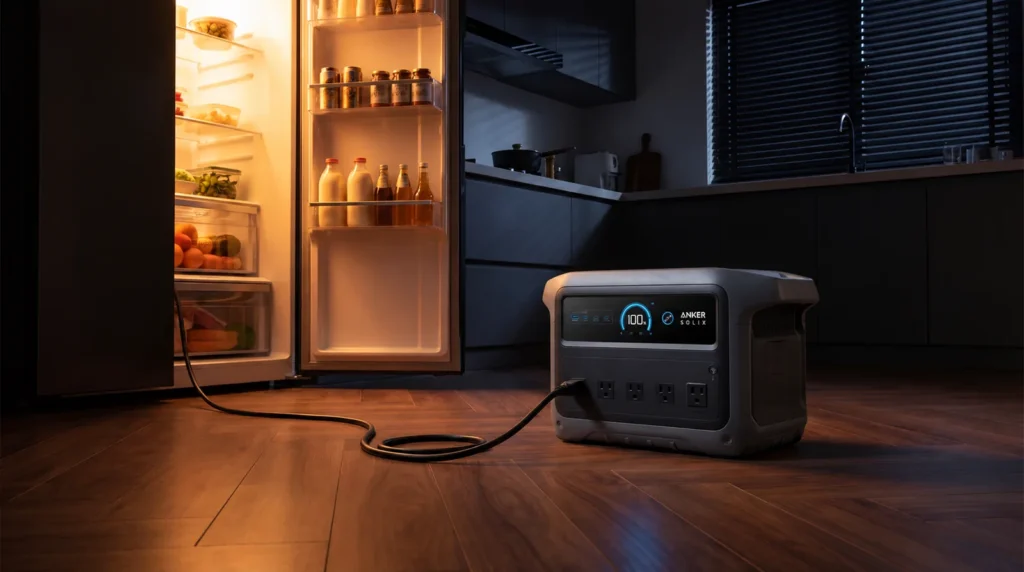
A portable power station can provide temporary backup power for a refrigerator. But if the refrigerator loses power, how long can the food last? See How Long Can a Refrigerator Go Without Power?.
After power is restored, how long does it take for the refrigerator to cool down again? Read How Long Does a Refrigerator Take to Get Cold?.