How Long Does a Refrigerator Take to Get Cold?
We may earn a commission from affiliate links to products on this page, at no additional cost to you. Learn more.
If you’re wondering, “How long does it take to get a refrigerator cold?”, start with what happened before the temperature changed. Is this a first startup, or did a normally working refrigerator just come back from a power outage, move, cleaning, or defrost? Either way, it can be unsettling to hear the unit running and still find the cabinet only mildly cool a few hours later.
You plug in a new refrigerator, the light comes on, and you can hear it running. But when you open the door a few hours later, the inside still feels only slightly cool. That’s usually when you start wondering whether it just needs more time or whether something isn’t quite right.
Here’s the useful short answer: most household refrigerators start getting noticeably cooler within a few hours, but reaching and stabilizing at a temperature that’s suitable for food storage can take close to a full day. In other words, when you’re wondering how long does it take to get a refrigerator cold, the clock gives you a rough expectation. Your refrigerator’s model guidance and actual temperature tell you when it’s really ready to use.
I don’t put much trust in the “it feels cold when I open the door” test. The air near the door can feel chilly pretty quickly, while the shelves, drawers, freezer compartment, and the rest of the refrigerator are still working their way down to a stable temperature.
Quick Answer
- It may start feeling cool within a few hours, but that does not automatically mean it is ready for perishable food.
- For food storage, check the actual temperature and your model instructions. The FDA recommends keeping the refrigerator at 40°F (4°C) or below and the freezer at 0°F (-18°C).
- Full stabilization varies a lot by brand and model. Some manufacturers allow close to a full day after startup for temperatures to settle, so use your own model guidance rather than a universal deadline.
Why Is the Refrigerator Still Not Cold After You Plug It In?
he air inside can cool before the liner, shelves, drawers, and freezer compartment all come down from their starting temperature. A large French-door or side-by-side model has more space to cool, and a warm room, repeated door openings, or a hot delivery environment can all stretch the refrigerator cooling time.
That is why I treat “a few hours” as a planning range, not a deadline.The better question is: how long does it take to get a refrigerator cold for this specific model? Manufacturer guidance often separates reaching normal operating temperature from full stabilization, so I would use the instructions for the exact model in front of me.
One more thing is easy to mix up: if the refrigerator was just transported, any required upright settling time happens before you plug it in. It is not part of the cooling clock. If the unit was carried on its side or at a steep angle, follow the installation instructions for that exact model rather than a universal “two-hour” or “24-hour” rule.
So if you are wondering how long a refrigerator takes to get cold after moving, separate the two questions: when is it safe to power on, and how long does it take to reach temperature after that?
When Can You Put Food in a New Refrigerator?
For most people, this is the real question. The milk, meat, leftovers, and frozen food waiting to be put away matter more than compressor theory. When you ask when can you put food in a new refrigerator, I would not use “it has been 12 hours” as the only test.
One important benchmark for us is an actual refrigerator temperature of 40°F (4°C) or below, with the freezer at 0°F (-18°C). That is the FDA guidance. Your manufacturer may give a more specific first-loading recommendation, so use the manual for your model.
Check the Actual Temperature, Not Just the Display
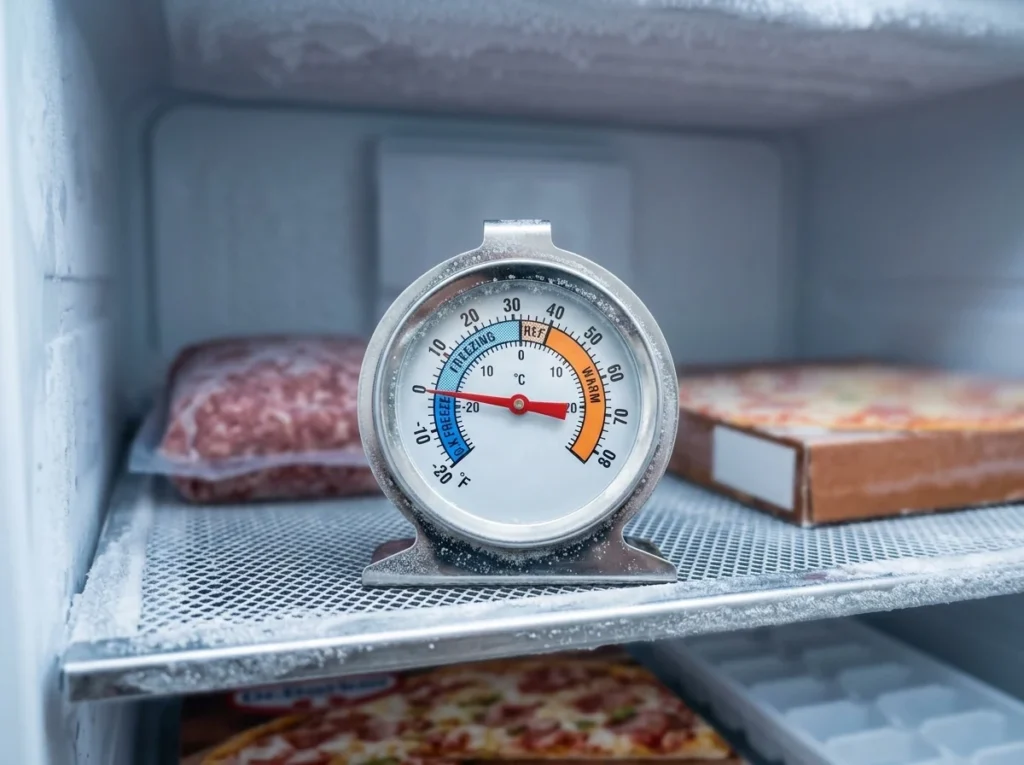
If you are trying to figure out how to tell if your refrigerator is cold enough, the tool I trust more than a quick hand check is a simple refrigerator thermometer. The control panel tells you what you asked the refrigerator to do; an independent thermometer helps tell you what is actually happening inside.
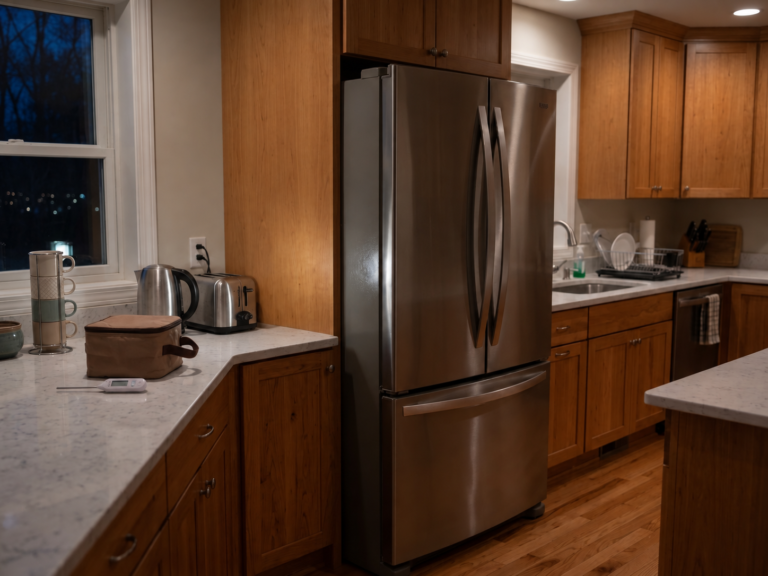
I prefer the basic kind: large numbers, easy to hang or stand on a shelf, and nothing complicated to set up. I would rather have a clear reading than extra features I may never use. Place it around the middle of the fresh-food compartment, away from the door and direct airflow, and let the reading settle before deciding. If you already own a suitable thermometer, use it.
If the refrigerator is not ready yet, do not let the groceries wait on the counter with it. Keep perishables in another working refrigerator or in a cooler with enough ice or ice packs to hold them at 40°F (4°C) or below.
Still Not Cold: Keep Waiting or Start Checking?
A more useful question than “how many hours has it been?” is whether the temperature is actually moving down. If the reading keeps dropping when you check at sensible intervals, the refrigerator may simply still be working toward its target. At that point, the model guidance matters more than a generic deadline.
If there is little or no cooling, start with the basics: make sure cooling is turned on, the doors are closing fully, no packaging is blocking the interior vents, and the unit is not in Demo or Showroom Mode. Some display modes leave the lights and controls on while cooling is disabled. The button sequence is model-specific, so check the manual instead of copying a shortcut from another refrigerator.
If you are past the manufacturer’s expected stabilization window and the actual temperature is barely changing—or you have an error code or clearly abnormal noise—contact the manufacturer or service department.
If an older refrigerator repeatedly runs above a safe temperature, that is a different decision. I would compare its age, the repair estimate, and whether the problem keeps coming back. If replacement makes more sense, I care more about clear temperature controls, a useful door alarm, steady temperatures, and decent service support than a flashy screen.
Can You Help a Refrigerator Cool Down Faster?
If the refrigerator is cooling normally, give it time. If you are looking for how to make a refrigerator cool faster, I would start with the simple things below rather than trying internet tricks like cranking everything to the coldest setting or stuffing the cabinet with ice.
Room temperature, refrigerator size, starting temperature, and frequent door openings all affect how long a fridge takes to get cold.
Restarting a Refrigerator and Other Cooling Questions
After Cleaning, Defrosting, or Moving
If you are searching how long does a fridge take to get cold after cleaning, how long does a fridge take to get cold after defrosting, or how long does a refrigerator take to get cold after moving, start with how much the cabinet actually warmed up. A quick cleaning while the interior stays cold is not the same starting point as a full defrost or a long shutdown that brings the whole cabinet back to room temperature. I would not memorize a separate universal hour range for every scenario.
After a Power Outage: Cooling Time and Food Safety
If you are asking how long does a fridge take to cool after a power outage, keep two decisions separate: how long the appliance takes to get cold again, and whether the food inside is still safe. A refrigerator becoming cold again does not make food safe again if it spent too long at an unsafe temperature. Use the outage duration, actual temperature, and type of food to make that call.
So how long can a refrigerator stay cold without power, and what should you do with the food inside? See our guide to refrigerator food safety during a power outage.
What If the Refrigerator Isn’t Cooling Properly After a Restart?
If the refrigerator was working normally before the outage, move, or restart but is now taking a long time to cool, do not jump straight to the conclusion that the compressor has failed.
Some refrigerators do not begin cooling the instant power returns. The controls or compressor may need a short restart and stabilization period. Designs vary, so the more useful question is not ‘how many minutes should I wait?’ but whether the refrigerator has actually started cooling again.
Start with checks that do not require taking anything apart.
Confirm that the outlet has power and the breaker has not tripped, and check whether the refrigerator lights and display are working. Then make sure the temperature setting was not reset and the unit did not switch into Demo Mode, Showroom Mode, Vacation Mode, or another special setting.
Close the doors fully and check that food, packaging, or ice is not blocking the interior vents.
If the refrigerator was just moved and was transported on its side or at a steep angle, check the manual for that exact model to see whether it needs to stand upright before being powered back on.
The most useful thing to watch next is not how the cabinet feels every time you open the door, but whether the actual temperature is trending down on a refrigerator thermometer.
If the temperature is gradually dropping, the system is at least recovering even if it has not yet returned to a normal food-storage temperature. Give it some time, keep the door closed, avoid loading a large amount of warm food, and make sure the refrigerator has the ventilation space required by its manual.
When to Stop Troubleshooting It Yourself
Repeated, obvious clicking without the refrigerator successfully starting.
Persistent error codes.
A breaker that keeps tripping.
Unusual heat at the plug, outlet, or appliance, a burning smell, or smoke.
The compressor appears to keep running, but the interior temperature still is not dropping after the recovery period recommended for the model.
Those symptoms can involve the controls, starting components, compressor, or sealed refrigeration system and are better handled by a qualified appliance technician.
Do not open electrical components or attempt to work on sealed refrigerant lines yourself.
One more reminder: a refrigerator getting cold again and the food inside still being safe are separate questions. After a long outage, food that spent too much time above a safe temperature does not become safe again just because the refrigerator later returns to normal.
Mini Fridges, Freezer Compartments, and Ice Makers
For how long does a mini fridge take to get cold, the smaller cabinet may help it cool more quickly, but room temperature and the specific model still make enough difference that I would not promise one number for every compact refrigerator.
For how long does a freezer take to get cold, do not assume the freezer is ready just because the refrigerator compartment feels cold enough. Check the two compartments separately; the freezer target is 0°F (-18°C). This article is referring to the freezer compartment in a household refrigerator, not a separate chest or upright freezer.
If you are also waiting for a new refrigerator to start making ice, do not treat ‘the refrigerator is cold’ and ‘the ice bin should be full’ as the same milestone. Ice production usually settles in after the refrigerator itself has cooled, and the timing varies by model, so use the ice-maker guidance for your refrigerator rather than a universal timer.
I Watch the Temperature More Than the Cloc
If I had to keep only one idea from this article, it would be this: time tells you roughly how long you may be waiting; temperature tells you whether the refrigerator is actually ready.
So the next time you are wondering how long does it take to get a refrigerator cold, do not set a hard deadline based on one number. Check the model guidance, keep the door closed, verify the actual temperature, and if the temperature is not moving down at all, then check the settings or contact service. That is a lot more useful than repeatedly guessing whether it feels ‘cold enough.
How long did your refrigerator take to reach its target temperature? If you share it in the comments, include whether it was a first startup, a power-outage recovery, or a restart after cleaning or defrosting. That context makes the number much more useful to the next person.
If You’re Replacing Your Refrigerator, These Are the Ones You Should Consider
If your refrigerator is simply cooling down normally, give it a little time. But if an older refrigerator repeatedly struggles to maintain a safe temperature and still won’t cool properly even after repairs, these are a few models you should consider first.