How Long Can a Refrigerator Go Without Power?
We may earn a commission from affiliate links to products on this page, at no additional cost to you. Learn more.
When the power suddenly goes out and the refrigerator goes quiet, what usually worries you isn’t the appliance itself. It’s what to do with all the milk, meat, eggs, leftovers, frozen food, and everything else packed inside.
So how long can a refrigerator go without power? And how long can food last in the fridge without power?
Here’s the most useful answer: if the refrigerator door stays closed, the refrigerator can usually keep food at a safe cold temperature for about 4 hours. A full freezer can hold its temperature for about 48 hours, while a half-full freezer can hold it for about 24 hours. Those time windows depend on one very important condition—the doors stay closed as much as possible.
So after the power goes out, don’t open the refrigerator every ten minutes just to feel around and think, “Hmm, it still seems pretty cool.” Every time you open the door, you’re letting out cold air you could have kept inside.
How Long Can a Refrigerator Go Without Power?
When the power goes out without warning, your first thought is probably the food inside the refrigerator.
And yes, throwing it away feels wasteful—but you also can’t just eat everything immediately. I understand the worry. So let’s answer the key question: how long can a refrigerator go without power?
Quick Answer:
|
Situation |
Approximate Time |
What Matters Most Right Now |
|---|---|---|
|
Refrigerator compartment |
About 4 hours |
Keep the door closed and note when the outage started. |
|
Full freezer |
About 48 hours |
Keep the door closed and let frozen food stay packed together. |
|
Half-full freezer |
About 24 hours |
Keep the door closed; group frozen food together if practical. |
|
Outage expected to last more than 4 hours |
Don’t just keep waiting |
Prepare a cooler, ice, or ice packs so perishable food can stay at 40°F (4°C) or below. |
FoodSafety.gov — Food Safety During Power Outage
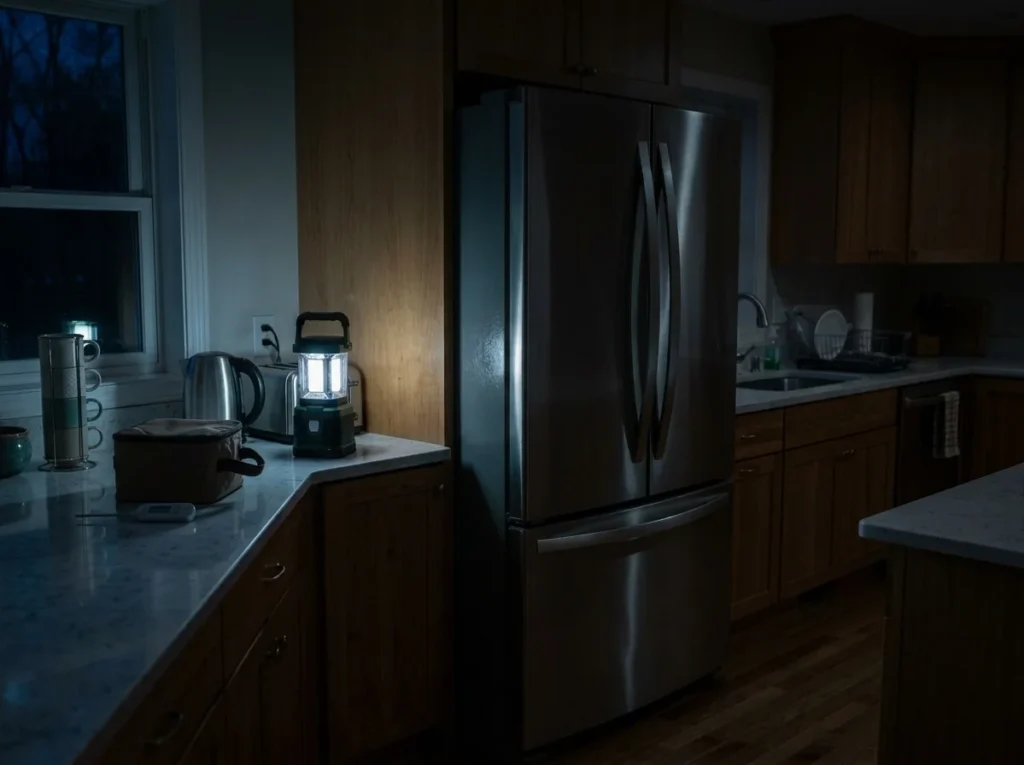
Those are the best-case time windows. If you keep opening the door, or accidentally leave it partly open even once, the refrigerator will warm up faster.
So what makes a refrigerator warm up faster? Here are the main things that can shorten how long a refrigerator stays cold without power:
- Door openings. This is the easiest factor to control. Every time you open the door, cold air escapes and warm room air gets in. During an outage, decide what you need first, then open the door once instead of checking over and over.
- Room temperature. A hot kitchen in summer and a cooler room in winter obviously do not start from the same place.
- How much food is inside. Food and drinks have thermal mass too. A fairly full refrigerator often holds cold better than one that is nearly empty, but that is not a reason to open the door after the outage starts and load it with extra items.
- The refrigerator’s temperature before the outage. A refrigerator that was already holding a stable, safe temperature is not the same starting point as one that was already having cooling problems before the power went out.
- Door seal condition. If the door gasket is worn or leaking, cold air will escape faster.
So there is no single number of minutes that applies perfectly to every household when you are asking how long can a fridge stay cold without power. For food safety, official time-and-temperature guidance is more reliable than “it still feels kind of cool.”
How to Keep Food Cold During a Power Outage
The first thing I would do isn’t reorganize the refrigerator or inspect every container. I’d write down one thing:
What time did the power go out?
It’s a small step, but it’s incredibly useful.
If you later need to decide whether a carton of milk, a plate of leftovers, or a package of meat is still safe, knowing whether the outage has lasted 2 hours, 6 hours, or 12 hours is a lot more useful than trying to remember, “I think I noticed the power was out sometime this afternoon.”
Then do the following:
Keep the refrigerator and freezer doors closed as much as possible.
Don’t keep opening the doors just to check the temperature.
If the outage may last more than 4 hours, get a cooler, ice, or ice packs ready.
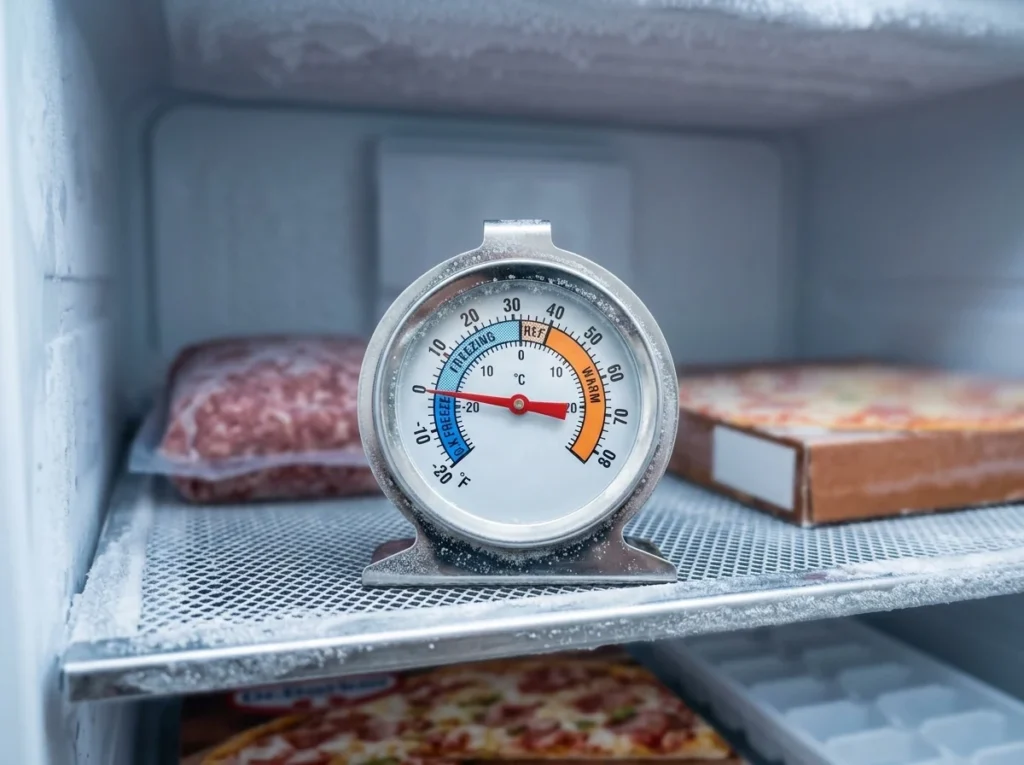
If you already have a refrigerator/freezer thermometer, use it to check the actual temperature instead of relying on how cold things feel.
Keep frozen food grouped together in the freezer so the items can help hold cold around one another.
The FDA also recommends having refrigerator and freezer thermometers, ice packs, ice, and coolers available ahead of time. If you expect the power to be out for more than 4 hours, you should consider moving refrigerated food into a cold environment that can continue to hold it at a safe temperature.
What If the Outage Looks Like It Could Last a While?
If you can already tell this is not going to be a ten-minute outage, don’t wait until the refrigerator is completely warm before you start looking for ice.
I usually leave the food in the refrigerator at first.
When it looks like the outage will last longer, you can move priority perishables such as milk, meat, eggs, and leftovers to a cooler with enough ice or ice packs. The key is to keep them at 40°F (4°C) or below. Ice can help maintain a low temperature, of course, but the important thing isn’t simply that you put a bag of ice in there. The real question is:
Is the food actually staying at a safe temperature?
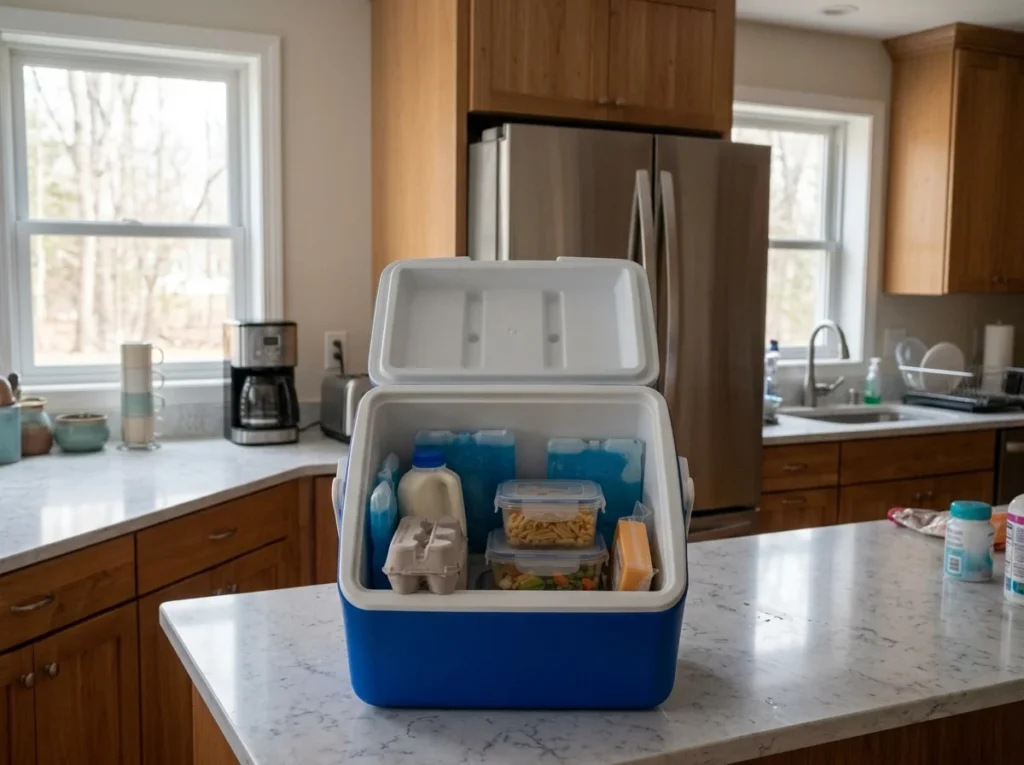
If you live somewhere that gets longer outages, keeping a few frozen ice packs and one or two decent coolers on hand is much more reliable than scrambling for supplies after the power is already out.
How Long Can Food Last in the Fridge Without Power?
This is what many people actually want to know. If the power has been out for no more than about 4 hours and the refrigerator door has stayed closed, official guidance says refrigerated food will generally remain safe.
If the outage has gone beyond 4 hours, don’t treat every food in the refrigerator as if it belongs in the same category.
Meat, milk, eggs, leftovers, and a bottle of mustard obviously do not carry the same level of risk.
There is one more point that is especially easy to get wrong:
“How long the power has been out” and “how long the food has actually been above 40°F” are not exactly the same clock.
FoodSafety.gov’s detailed food chart uses the condition “above 40°F (4°C) for more than 2 hours” for many perishable foods. At the same time, the broader outage guidance also uses about 4 hours for a refrigerator that stays closed.
So don’t simply add those two numbers together and invent a “6-hour rule.”
After 4 hours, it’s more reliable to judge by the specific food, the actual temperature, and the official Keep/Throw Out chart than to do your own math.
Which Foods Need the Most Caution?
The foods I would pay attention to first are the perishable foods most households keep around all the time:
Food
Why It Needs Extra Attention After an Outage
|
Milk and most perishable dairy products |
Risk rises quickly as the temperature increases. |
|
Raw and cooked meat, poultry, and seafood |
These are high-risk perishable foods. |
|
Eggs and foods made with eggs |
They need continuous refrigeration. |
|
Leftovers, soups, stews, and casseroles |
Being cooked already does not mean they can sit warm for a long time. |
|
Cut fruit, pre-cut vegetables, and cooked vegetables |
They cannot be treated the same way as whole fruits and vegetables. |
|
Soft cheese and shredded cheese |
The handling guidance is not the same as it is for hard cheese. |
Food
Why It Needs Extra Attention After an Outage
|
Milk and most perishable dairy products |
Risk rises quickly as the temperature increases. |
|
Raw and cooked meat, poultry, and seafood |
These are high-risk perishable foods. |
|
Eggs and foods made with eggs |
They need continuous refrigeration. |
|
Leftovers, soups, stews, and casseroles |
Being cooked already does not mean they can sit warm for a long time. |
|
Cut fruit, pre-cut vegetables, and cooked vegetables |
They cannot be treated the same way as whole fruits and vegetables. |
|
Soft cheese and shredded cheese |
The handling guidance is not the same as it is for hard cheese. |
Milk and other perishable dairy products deserve extra attention. Don’t take a sip just because they smell fine. Food safety is not something to confirm by “trying a little.”
FoodSafety.gov specifically warns against tasting food to decide whether it is safe.
Some Foods Really Can’t Be Treated the Same Way
What If You Have No Idea How Long the Power Was Out?
This situation is actually pretty common.
The power may have gone out while you were asleep and you only discover it the next morning. Or you may have been away all day and come home after the electricity has already been restored.
In that situation, one of the riskiest ways to reason about the food is:
“The refrigerator is cold again now, so the food must be fine.” It doesn’t work that way.
If you don’t know when the outage started and you don’t have a reliable temperature record, it is difficult to work backward from “it feels cold now” and know whether a carton of milk had already warmed to an unsafe temperature several hours earlier.
For perishable food whose safe conditions I can’t confirm, I usually throw it away. I follow the same official principle:
When in doubt, throw it out.
How Long Will a Freezer Last Without Power?
The freezer usually gives you a lot more time than the refrigerator compartment.
If the door stays closed:
- A full freezer: about 48 hours
- A half-full freezer: about 24 hours
The difference between “full” and “half-full” is pretty easy to picture: a large amount of fully frozen food packed together acts like one big cold mass.
If the freezer isn’t full, you can group the food together instead of leaving it spread out across the compartment.
Can Frozen Food Be Refrozen After the Power Comes Back?
Start by looking at its actual condition.
FoodSafety.gov says that if food still contains ice crystals, or the actual temperature is still 40°F (4°C) or below, many foods can be refrozen, although the texture and quality may suffer.
But “it still has ice crystals” is not a universal rule for every frozen food.
For example, the official chart treats ice cream and frozen yogurt more strictly.
After a Power Outage: Check the Food First, Then the Refrigerator
When the lights come back on, great—that really is a relief:
“Okay, the refrigerator is running again. Problem solved.”
Actually, there are still two questions, and the order matters.
First: Decide What to Do With the Food
Handle the food-safety question from the outage first.
If some perishable foods spent too long at an unsafe temperature, the refrigerator cooling back below 40°F later does not make those foods safe again.
So what should I throw out after a power outage that lasted several hours?
Here’s my personal choice: if something is completely thawed, soft, or leaking, I throw it away without hesitation. I also discard ice cream and cream-based products once they have thawed.
Second: Confirm That the Refrigerator Has Started Cooling Again
Check whether the lights and display are working, then use the actual temperature to see whether the refrigerator is cooling down.
Don’t assume the compressor has failed just because the refrigerator is not fully cold 20 minutes after the power comes back.
Cooling back down takes time.
So how long does a refrigerator take to get cold again after the power comes back on?
Three Things to Remember
You do not need to memorize dozens of rules just because the power went out.
Start with these three things:
How long the refrigerator can go without power is a time question.
Whether the food inside is still safe to eat ultimately comes down to time + temperature + food type + your health.