How to Organize Your Laundry Room So It Stays Organized
We may earn a commission from affiliate links to products on this page, at no additional cost to you. Learn more.
I’m not much of a perfectionist, but a clean living space always makes me feel better. The laundry room is one of those places that can get messy quietly: detergent lands on the counter, empty bottles stay in the cabinet, and the hamper somehow finds the one spot that blocks the door.
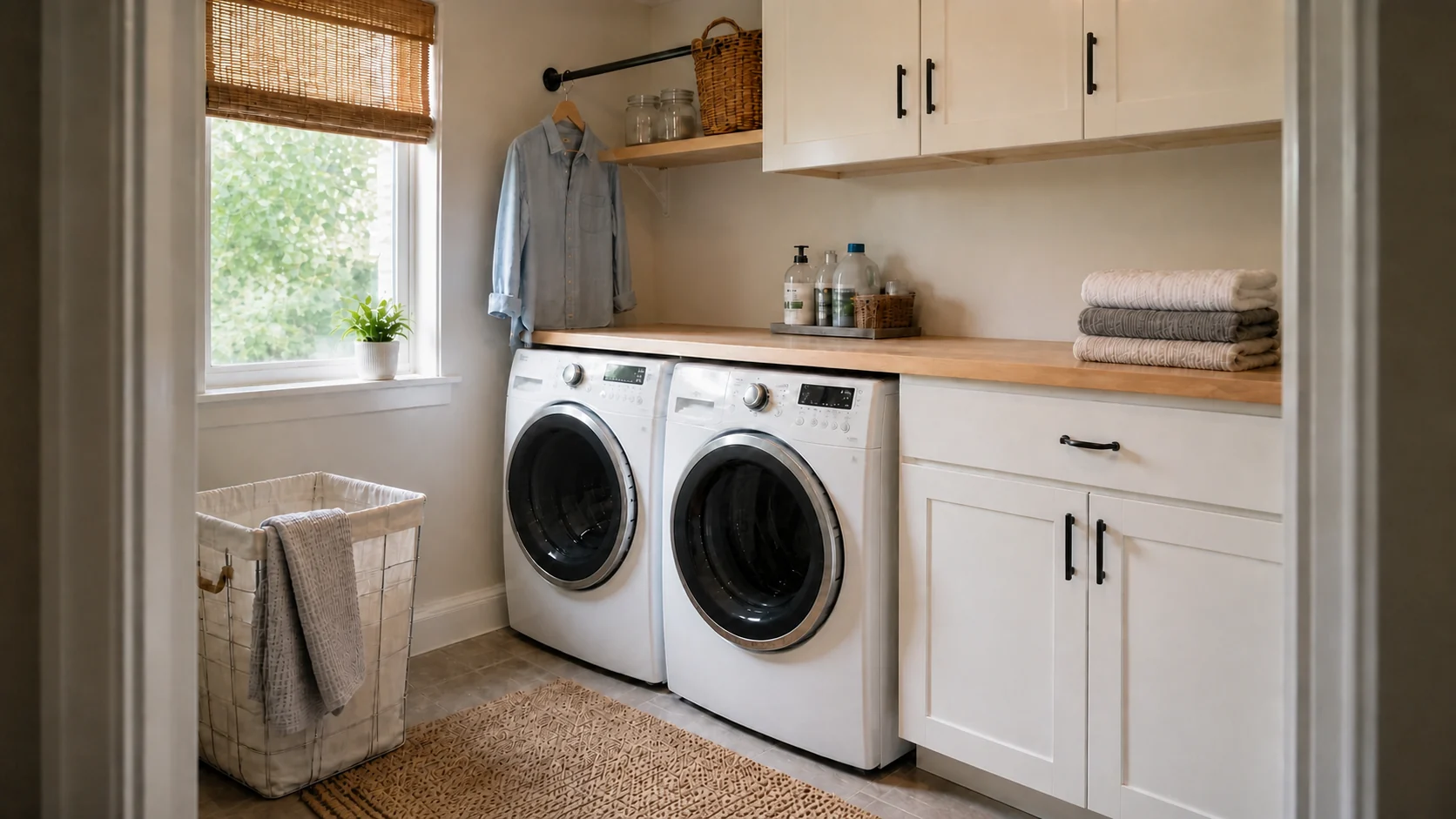
I like a laundry room that feels clean and tidy without turning into a room nobody is allowed to touch. Today I want to share how I think about the space in real life—what needs to be within reach, what can move out, and what makes the whole routine easier to keep up with.
Good laundry room organization should make the next step obvious: dirty clothes come in, supplies are easy to reach, wet items have somewhere to hang, clean clothes have somewhere to fold, and the room can recover quickly when it gets messy again.
So if you’re figuring out how to organize your laundry room, that’s the goal: a room that works on a regular Tuesday, not just one that looks good in a before-and-after photo.
Clear Out What Doesn’t Belong
Before you organize a shelf, open the cabinets and look at what is actually in there—not what you think is in there.
Half-used cleaners. A stain remover you stopped using. Empty packaging. Random household supplies that somehow landed in the laundry room because nobody knew where else to put them.
The first step in organizing a laundry room is giving yourself enough room to see the problem. Move out anything that clearly belongs somewhere else. Toss empty containers and products that are no longer usable.
You do not need to turn this into a six-hour decluttering marathon. The point is simply to declutter the laundry room enough to see what actually deserves space.
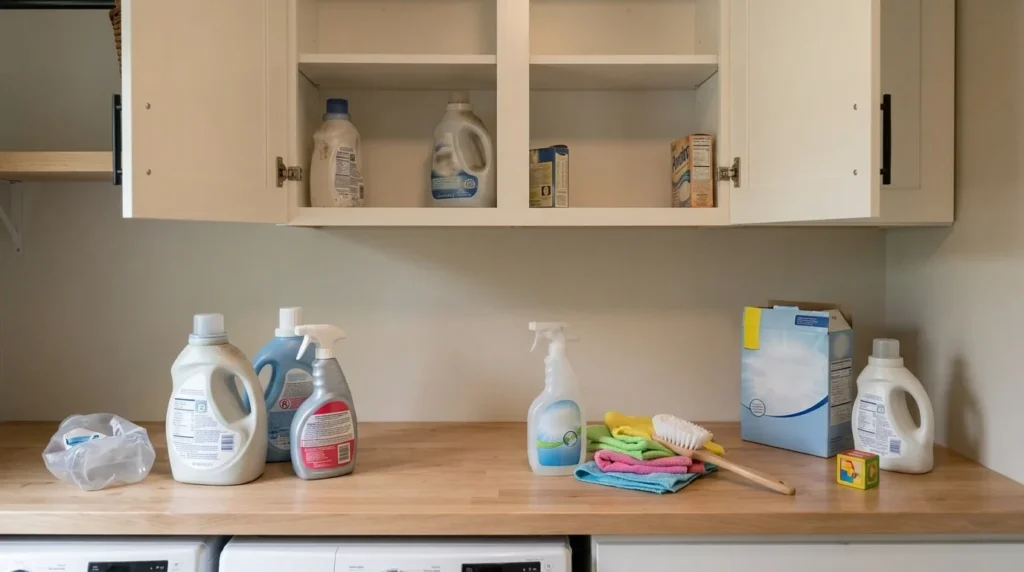
Then group what remains. Detergent and stain products together. General cleaning supplies together. Ironing or steaming supplies together. Extra household stock together—if it really needs to live here.
This is also when overbuying becomes a little embarrassing. Three half-open bottles of almost the same cleaner are much easier to notice when they are sitting side by side.
Before buying new containers, look around the house. A spare basket, tray, small bin, or shallow bowl may already solve the problem. I would rather start with an imperfect container that works than buy six matching bins before I know what needs to go inside them.
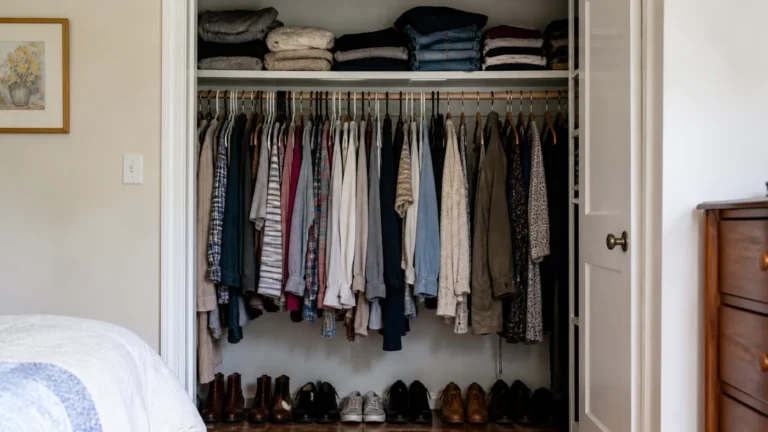
I use the same edit-first approach when I’m figuring out how to declutter a closet: decide what actually deserves the space before buying anything to organize it.
Build Zones Around How Laundry Actually Moves
Next, stop looking only at the cabinets and look at the whole flow of the room.
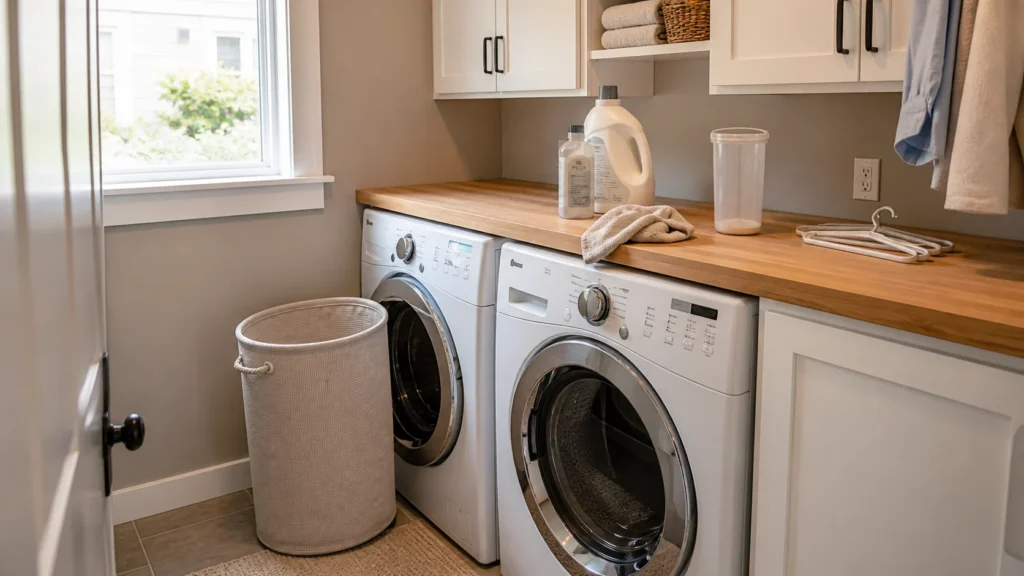
I like to follow the path clothes actually take: dirty clothes come in → they get sorted → washed → dried or hung → folded → carried back out. If one step always makes you walk back and forth, hunt for a surface, or temporarily pile things somewhere, that is the part I would fix first.
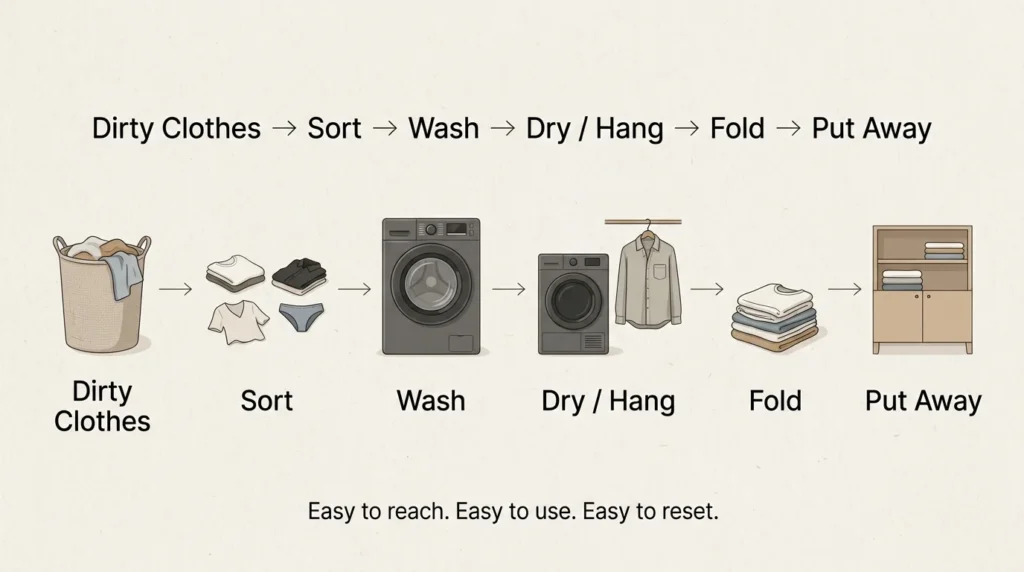
A useful laundry room organization system should follow those movements. Keep detergent and stain treatment near the washer. Keep drying supplies near the dryer. Put hangers close to where you actually hang clothes. If you fold on top of the machines, protect that surface instead of covering it with decorative storage.
Zones do not need fancy names. “Wash.” “Dry.” “Cleaning.” “Backups.” That is plenty.
If more than one person uses the laundry room, there is an easy test: can someone who did not create the system figure out where an item belongs without asking you? If not, the system may be a little too clever.
Store Supplies Where You Actually Use Them
A lot of laundry room organization ideas get complicated right here. But the best storage spot is usually the one that saves you a few unnecessary steps.
Everyday detergent should be easy to reach. It should not live on the highest shelf just because the bottle happened to fit there. Heavy refill bottles do not belong somewhere that requires balancing on a stool, and something you use once every three months does not need prime eye-level real estate.
If you are working out how to organize laundry room cabinets, organize by frequency first. Keep everyday products toward the front. Backups can sit higher or farther back. Rare-use supplies can take the less convenient spots.
Deep cabinets create another problem: things disappear. One bottle slides behind another, then behind a basket, and six weeks later you buy a replacement because you forgot it existed. Have you done that too?
That is when a turntable or pull-forward bin becomes useful—not because every cabinet needs one, but because it solves a visibility problem.
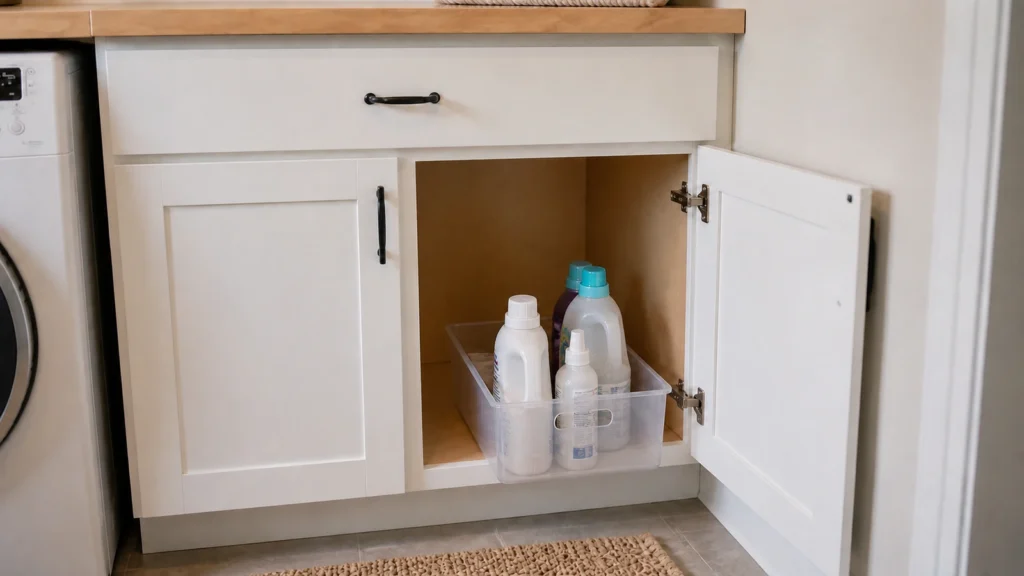
A pull-out bin can be better for packets, cloths, or mixed small items. If the cabinet is already shallow enough to see at a glance, you may not need either one.
Open shelves need even more restraint. When deciding how to organize laundry room shelves, let each shelf do one or two jobs instead of five. Detergent and stain care. General cleaning supplies. Extra towels. Done.
Empty space is useful space.
Fix the Bottlenecks: Hampers, Hanging, Folding, and Lint
Sometimes the problem is not a lack of storage. It is one annoying step in the laundry routine that keeps getting in the way.
Start with the hamper. If you have been wondering where to put a laundry hamper, do not start with the hamper itself. Start with how your household sorts dirty clothes.
If everyone already brings sorted clothes from their bedrooms, a giant three-section sorter may be unnecessary. If you sort lights, darks, towels, and delicates before washing, a divided hamper near the washer can save a lot of reshuffling. That is how I prefer to do it.
A huge hamper that blocks a cabinet door is not an organizing solution.
Next comes air-drying. If you regularly have clothes that cannot go in the dryer, give them a real place to go. A short hanging bar, a few wall hooks, or a fold-down drying rack can keep damp clothes off doorknobs and bathroom rails.
I have run into the clearance problem myself: if the rack is placed badly, it can fight with the lid of a top-loading washer. Measure the opening space before installing anything.
Folding deserves a real landing spot too. If clean clothes sit in a basket for two or three days, the issue may not be that you hate folding—it may be that there is nowhere comfortable to do it. Even keeping one clear section of countertop above the machines can be more useful than adding another pretty container.
Lint and small trash are another tiny problem that becomes annoying fast. If the trash can is several steps away and your hands are full, lint will eventually stay on top of the dryer. In a small room, a magnetic lint bin can remove that friction; if you already own a small container that works, there is no reason to buy another one.
Make a Small Laundry Room Work Harder
Good small laundry room organization usually comes from using fewer systems, not squeezing in more of them.
If you are figuring out how to organize a small laundry room, look first at the things that physically limit the space. Is the washer top-loading? Will a cabinet door hit the drying rack? Can you walk past the hamper when it is full? Can you actually reach the highest shelf?
Will a slim rolling cart pull out easily, or will it get wedged between the machines and turn into a permanent cave for forgotten products?
The same idea applies if you are dealing with how to organize a tiny laundry room.

Vertical space helps. Walls, the back of a door, and the area above the machines can all be useful. But “higher” does not automatically mean “better.” Keep lighter, less-used things up high. Everyday products should still be comfortable to reach.
A lot of the best laundry room organization ideas for small spaces are almost boring: keep the floor as clear as possible, reduce duplicates, hang what can be hung, and do not store something here just because there is technically room.
Good space-saving small laundry room ideas should solve one clear problem: a basket that folds flat when you are done, a rolling cart that truly fits the narrow gap, or wall storage that keeps the walkway open.
There are endless small laundry room organizing ideas online. Before adding one, ask a very unglamorous question: what problem does this actually fix for me? If there is no good answer, skip it.
Add a Reset and Restock Routine
The real test of an organizing system is not when the labels are straight and the counter is empty. It is two busy weeks later.
That is why useful laundry room solutions need to include what happens after the room starts being used again.
Give yourself a short reset. Most weeks, five minutes is enough: put stray supplies back, throw away empty packaging, return hangers, wipe up obvious spills, and move folded clothes out of the room.
Then check what is actually running low.
A simple laundry room restock rule can prevent both extremes: “We are completely out of detergent” and “Why do we own seven bottles of detergent?”
For products you truly use all the time, try one open item plus one backup. When the backup becomes the active bottle, add it to the shopping list. That is it.
If several people share the laundry room, simple labels can help. They do not need to list every item allowed in a basket. “Stain Care” or “Backups” is enough. A piece of tape and a marker can do the job just as well as a label maker unless you actually enjoy making labels.
And if the system keeps failing in the same place, change the system. If nobody puts things back into six tiny categories, try three bigger ones. If the hamper always blocks the walkway, move it. If nobody wants to refill the pretty dispenser, stop refilling it.
An organized laundry room should be easy to recover, not easy to disappoint.
Let the Room Look Used
If you are still wondering how to organize a laundry room, start smaller than you think: remove what does not belong, group what remains, put things near the point of use, fix the biggest bottleneck, and keep the reset simple enough that you will actually do it.
A tidy laundry room is not a spotless display that nobody is allowed to touch. It is a space that works with you instead of against you.
That means you can start a load without digging for supplies, fold clothes without clearing half the counter first, and walk away knowing the room will take a few minutes—not twenty—to put back together.
You do not need expensive products or a full renovation. Clear the excess, build zones around the way you actually do laundry, fix the everyday friction points, and keep the reset simple. That is enough.