How to Declutter Your Closet: What to Keep, Donate, and Let Go
We may earn a commission from affiliate links to products on this page, at no additional cost to you. Learn more.
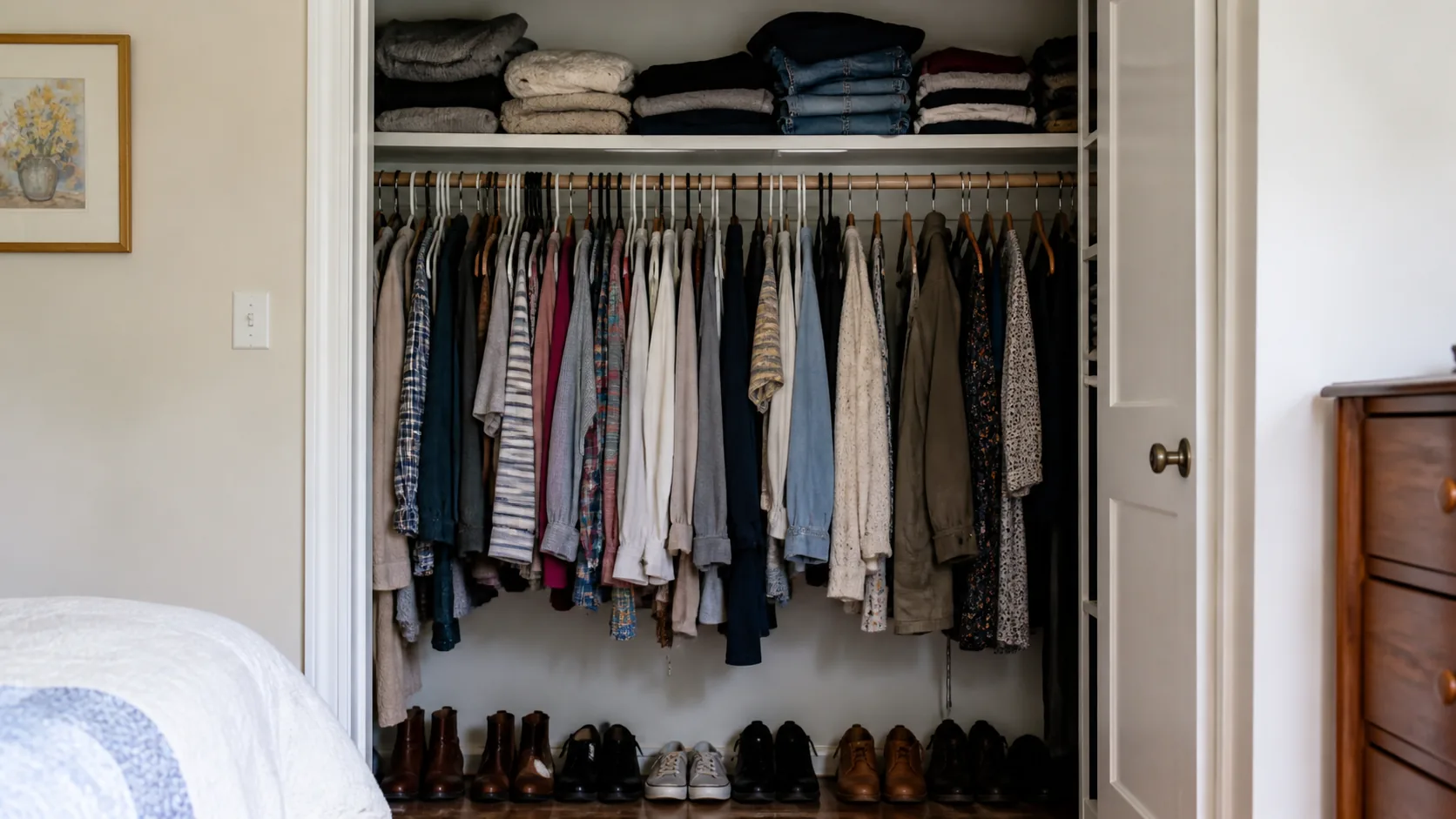
I’ve had that oddly frustrating moment too: a closet packed with clothes, followed by the thought, “Why do I still have nothing to wear?”
Eventually I realized that more clothes weren’t giving me more options. The pieces that didn’t fit quite right, never felt comfortable, or belonged to a version of my life I wasn’t living anymore were making the useful things harder to see.
So I don’t think of a closet declutter as a challenge to get rid of as much as possible. I think of it as editing: keeping the clothes that work for your body and your real life, and making a clear plan for the rest.
Learning how to declutter your closet doesn’t mean emptying everything in one heroic afternoon. Start with the easy decisions. We’ll get to the complicated ones.
How to Declutter Your Closet Without Doing It All at Once
If you have a few uninterrupted hours, taking everything out at once can work well. But if a bed covered in clothes is likely to make you regret starting, work by category instead: tops, pants, dresses, jackets, shoes, or bags.
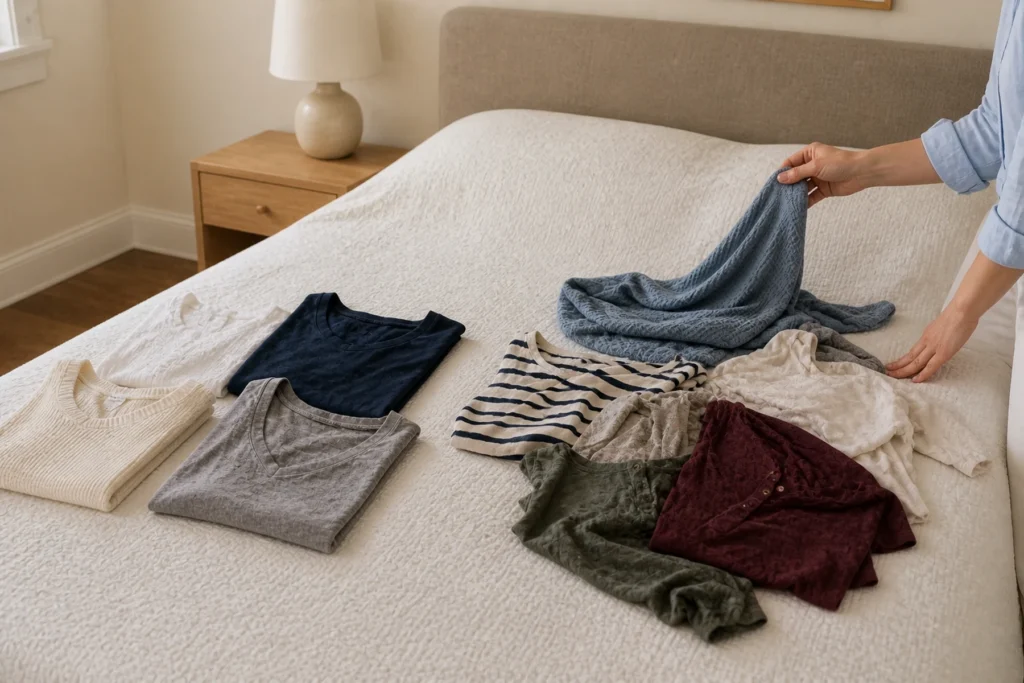
Even a 20- or 30-minute session counts. I’d rather finish one drawer than turn the whole bedroom into a project I’m too tired to finish.
For the first pass, look for the obvious things:
- clothes that are badly damaged and realistically won’t be repaired
- pieces that are uncomfortable every time you wear them
- items that clearly don’t fit
- clothes you simply don’t like
- duplicates when you always choose the same favorite
- things you reach past every single time
This first round isn’t about being ruthless. It’s about creating enough breathing room to make the harder decisions with a clearer head
The five questions I use before keeping a piece
Decluttering clothes doesn’t need a complicated scoring system. If every T-shirt has to pass a 17-question interview, the system has become its own problem.
Does it fit me now?
The important word is now. Bodies change, of course, and there are perfectly good reasons to keep a small range of sizes during pregnancy, recovery, or a genuine period of change. But a small, intentional buffer is different from letting half the closet wait for a future version of you.
Do I actually choose it?
Some clothes are perfectly fine on paper. Nothing is wrong with them; you just never reach for them. I like to ask, “If I were getting dressed tomorrow, would I honestly choose this?” If the answer is always “maybe,” that’s useful information.
Is it comfortable in real life?
This matters more to me now than it used to. A top can look great on a hanger and still spend the day riding up, pulling in the wrong place, or making you adjust it every ten minutes. Clothes that work in real life usually let you forget about them once you’re dressed.
Does it still fit the life I’m living?
Sometimes the clothes haven’t changed. Your life has. Maybe you used to be in an office five days a week and now work mostly from home. Maybe you once needed formal clothes constantly and now need them twice a year. A closet doesn’t have to archive every version of your life.
Would I buy it again today?
This is one of my favorite checks. Pretend the item isn’t already yours. If you saw it in a store today, would you try it on? Would you pay for it again? If the answer is an immediate no, ownership alone may not be a strong enough reason to keep it.
A quick keep-or-let-go check
- Does it fit now? — Yes / Clearly no
- Do I choose it? — Regularly / for a real occasion / Rarely or never
- Is it comfortable? — Yes / I keep adjusting it
- Does it fit my current life? — Yes / It belongs to an old routine
- Would I buy it again? — Yes / Definitely not
- Is it in usable condition? — Yes / Too damaged
This isn’t a test. A formal coat obviously won’t be worn as often as your favorite jeans. The point is simply to stop keeping things by default.
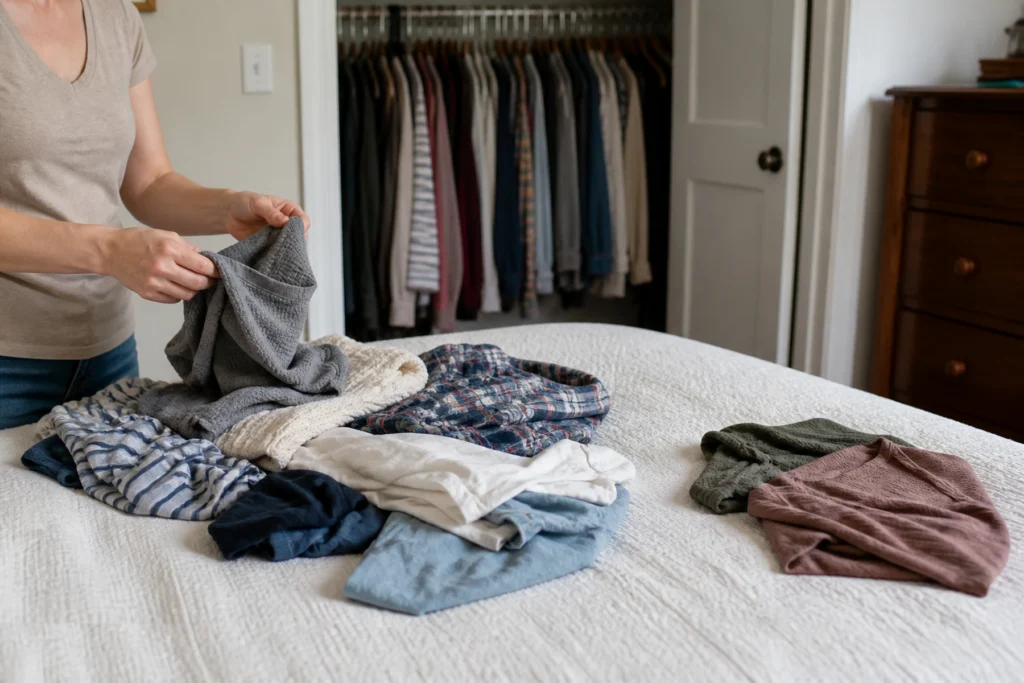
The clothes that are actually hard to let go of
The easy T-shirts usually aren’t what slow a closet cleanout down. The difficult pieces tend to come with money, memories, or a very persistent “maybe someday.”
The expensive thing I never wear
“I paid too much for this to get rid of it” is an understandable thought. Unfortunately, another three years on the hanger won’t bring the money back. If the piece is in good condition and has real resale value, selling can make sense—just give the plan a deadline so “I’m going to sell it” doesn’t become a permanent storage category.
The clothes that might fit someday
I don’t think every future-size item has to go. I do think it helps to give that category a limit: one small bin or one short section of hanging space. Keep the pieces you genuinely love, that are reasonably close in size, and that you would actually wear again.
Sentimental clothing
Some clothes stop being ordinary clothes and become memories. I don’t think a wedding outfit, a graduation piece, or something connected to someone you love needs to pass a “Have I worn this lately?” rule. But sentimental pieces also don’t have to compete with everyday clothes for prime closet space.
If a special piece needs to stay hanging and protected from dust, a breathable garment bag can be useful. If it doesn’t need one, skip it.
The never-ending maybe pile
Maybe piles are sneaky because they feel like a decision when they’re really just a delay. If I genuinely can’t decide, I prefer a dated maybe box—60 days is plenty for most everyday clothing.
Use a cardboard box you already own. There is no reason to buy something just to start decluttering.
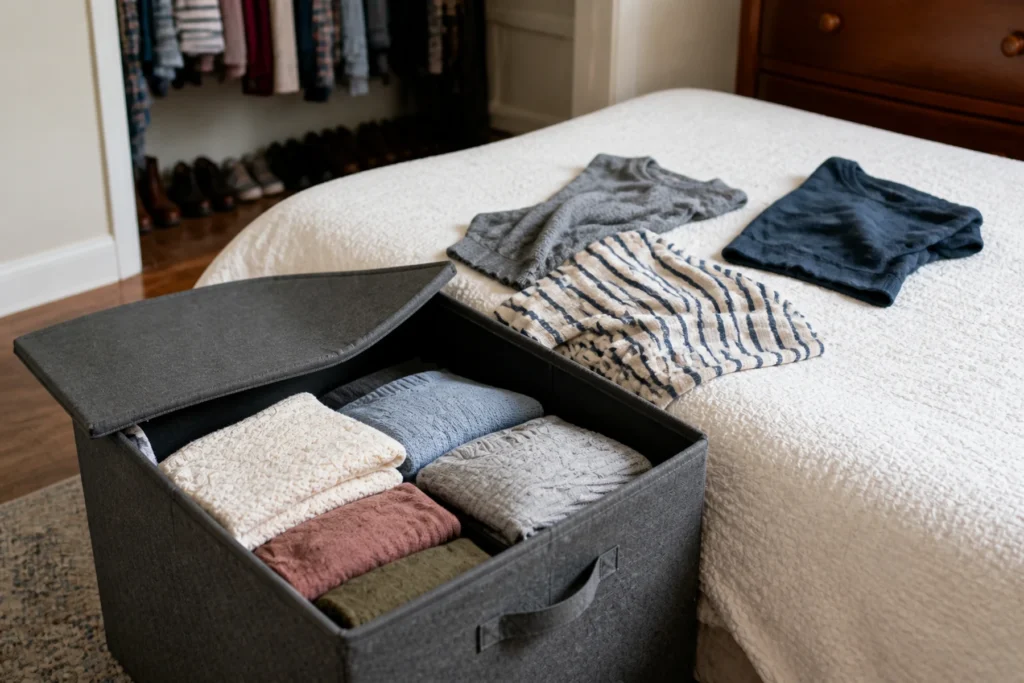
If the box really does need to live on an upper closet shelf for a while, a lidded fabric storage bin is one tidy option, but it should solve a real storage need—not become permission to postpone every decision.
Don’t forget shoes, bags, and accessories
It’s surprisingly easy to finish the hanging section and then look down at a floor that is still completely full.
I use the same basic questions for shoes and bags: Is it comfortable? Is it in good condition? Do I own several that do the same job? Do I actually choose it?
The question isn’t whether something is still a perfectly nice object. It’s whether it still has a real job in your life.
Putting it in a donation bag is only half the job
This is where a lot of closet decluttering quietly stalls. The clothes leave the closet, and then three donation bags live in the bedroom corner for six weeks.
That is, technically, just relocated clutter.
Decide the exit route while you’re sorting:
For me, a closet purge isn’t finished until the things I’m letting go of have actually left the house.

Only then do I think about organizing
I don’t love starting a decluttering project by buying organizers. Sometimes we think we have a storage problem when we really have a volume problem.
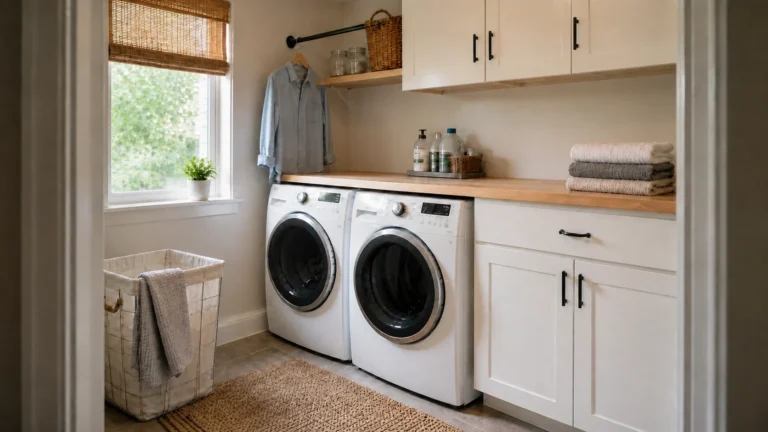
The same edit-first principle applies to organizing a laundry room: clear out what doesn’t belong before deciding which storage tools are actually useful.
Once you know what is staying, keep the reset simple: group like items, put frequently worn pieces where they’re easy to reach, give categories a rough space limit, and leave a little breathing room.
If you have already edited the wardrobe and the hanging rod is still crowded because bulky hangers take up a surprising amount of room, slim non-slip hangers can help. But if the real problem is still too many clothes, new hangers won’t fix it.
The part I care about most: keeping the closet from filling up again
The prettiest moment in a closet reset is usually the day you finish it. The more useful part is what happens three months later.
What has helped me most is asking a few questions before something new comes home: Will I actually wear it? Is it comfortable enough for real life? Can I wear it more than one way? Will I still like it after the novelty wears off?
Look at the category before adding another one
I don’t treat one-in-one-out as a law. But before buying another pair of jeans, it takes ten seconds to look at the jeans already there. Is one of them quietly done?
Don’t rush to fill the empty space
An edited closet can create a strange urge to shop for all the “gaps” you suddenly see. Live with it for a few weeks. If the same missing item keeps becoming a real problem, then you have much better evidence that you need it.
Do a ten-minute seasonal check
You don’t need another dramatic closet purge every three months. Just notice what you didn’t wear all season, what still needs repair, whether duplicates are creeping back in, and whether the maybe box has reached its date.
The easier maintenance is, the more likely it is to happen.
I’m not trying to create a bigger closet anymore
I used to assume that more clothes meant more choice. In practice, too many “pretty good” pieces can hide the things you genuinely enjoy wearing and make an ordinary morning decision harder than it needs to be.
Now I care more about whether something fits, feels good, works for my real life, and gets worn.
Your closet doesn’t need to look like a magazine spread, and it doesn’t need to be especially minimalist. If you open the door and most of what you see feels like something you would happily wear, that is enough.
Sometimes the closet doesn’t need to be bigger. It doesn’t even need another organizer.
“It just needs fewer ‘maybe someday’ clothes.”